Every Oscillations (SHM) question from past AP EAPCET and TS EAPCET papers, with options and answers. Newest first.
208questions
141papers covered
4%of Physics questions, 2022–2026
2010–2026years
Guide at a glance
Oscillations and simple harmonic motion form a cornerstone of Class 11 mechanics in both Andhra Pradesh and Telangana engineering entrance papers. In the papers we hold for AP and TS EAPCET between 2022 and 2026, the chapter contributed 122 questions across 77 papers.
A body executes SHM under the influence of one force and has the time period of $T_1$ seconds. The same body executes SHM with a time period of $T_2$ seconds when under the influence of another force separately. When both forces act simultaneously and in the same direction, then the time period of the same body is
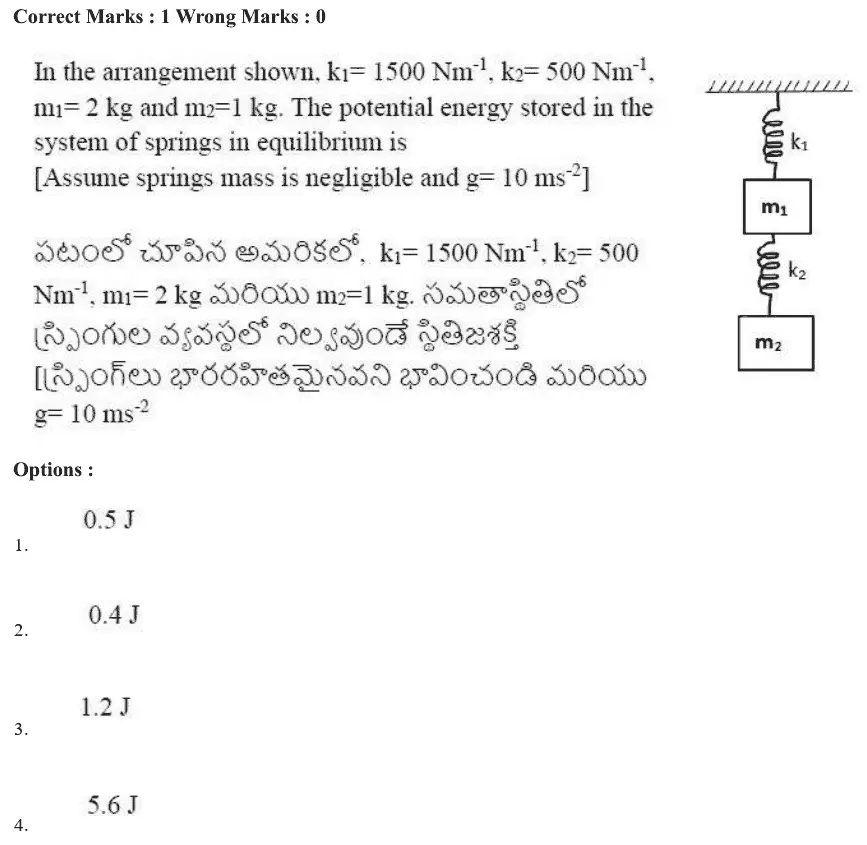
In the arrangement shown, $k_1 = 1500\ \mathrm{Nm^{-1}}$, $k_2 = 500\ \mathrm{Nm^{-1}}$, $m_1 = 2\ \mathrm{kg}$ and $m_2 = 1\ \mathrm{kg}$. The potential energy stored in the system of springs in equilibrium is [Assume springs mass is negligible and $g = 10\ \mathrm{ms^{-2}}$]
The equation of motion of a particle executing simple harmonic motion is given by $X = \sqrt{2}\,[1.2 \sin 2t - 1.6 \cos 2t]$, where $'X'$ is displacement in metre and $'t'$ is time in second. The velocity of the particle at a time of $0.125\pi$ s is
If the minimum time taken by a particle executing simple harmonic motion to move from extreme position to a point at a displacement of 86.6% of the amplitude is T, then the minimum time taken by the particle to move from mean position to a point at a displacement of 86.6% of the amplitude is,
The maximum kinetic energy of a pendulum executing simple harmonic motion is E. If the length of the pendulum is doubled and the amplitude of motion is halved, then the maximum kinetic energy of the pendulum is
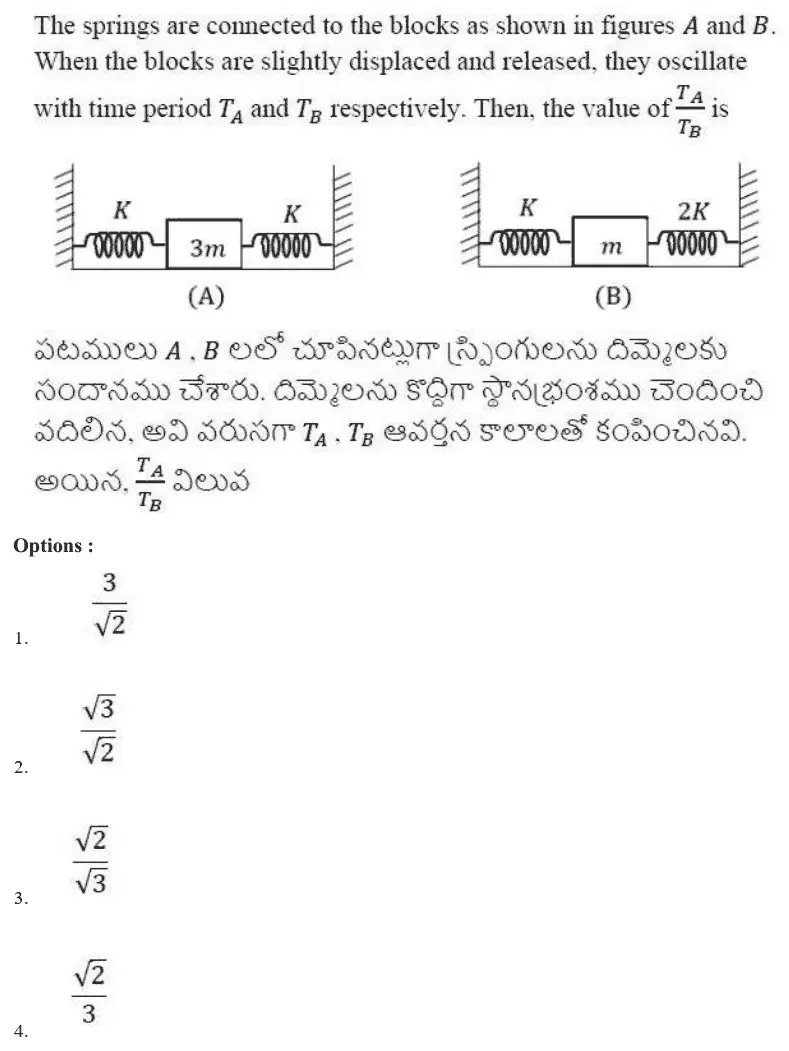
The springs are connected to the blocks as shown in figures $A$ and $B$. When the blocks are slightly displaced and released, they oscillate with time period $T_A$ and $T_B$ respectively. Then, the value of $\frac{T_A}{T_B}$ is
The energy of a particle executing Simple Harmonic Motion ($SHM$) is given by $E = Ax^2 + BV^2$. Here 'x' is the displacement of the particle from mean position and 'V' is its velocity at 'x' and A and B are constants. The INCORRECT statement is
A particle is executing simple harmonic motion with time period $T$ and amplitude $A$. The distance travelled by the particle in $\frac{T}{12}$ time starting from rest is
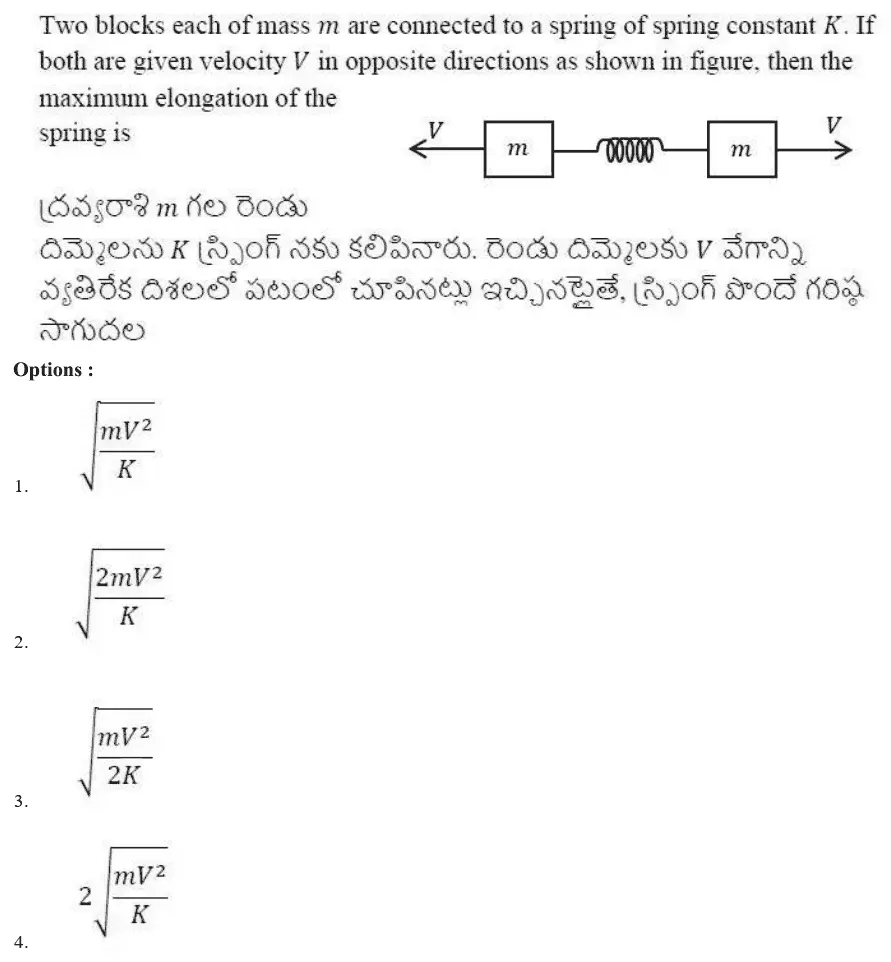
Two blocks each of mass $m$ are connected to a spring of spring constant $K$. If both are given velocity $V$ in opposite directions as shown in figure, then the maximum elongation of the spring is
The displacement of particle executing simple harmonic motion is given by $x = 6\sin\left(2\pi t + \frac{\pi}{4}\right) m$. The amplitude and maximum speed are given by
A particle starting from the origin executes simple harmonic motion along $x$-axis. Its velocity at any instant $t$ is given by $v_x = 22\cos\left(\frac{\pi t}{2}\right)\ cm\ s^{-1}$. The total distance covered by the particle in time $t = 4.5\ sec$
A particle is executing simple harmonic motion with an amplitude of 25 cm. If the kinetic energy of the particle at the mean position is 5 J, then the maximum force acting on the particle in its motion is
The mechanical energy of a damped harmonic oscillator at a time t = 0 is 80 J. If its mechanical energy becomes 40 J after completing 15 oscillations, then the extra oscillations the oscillator has to complete so that its mechanical energy becomes 10 J is
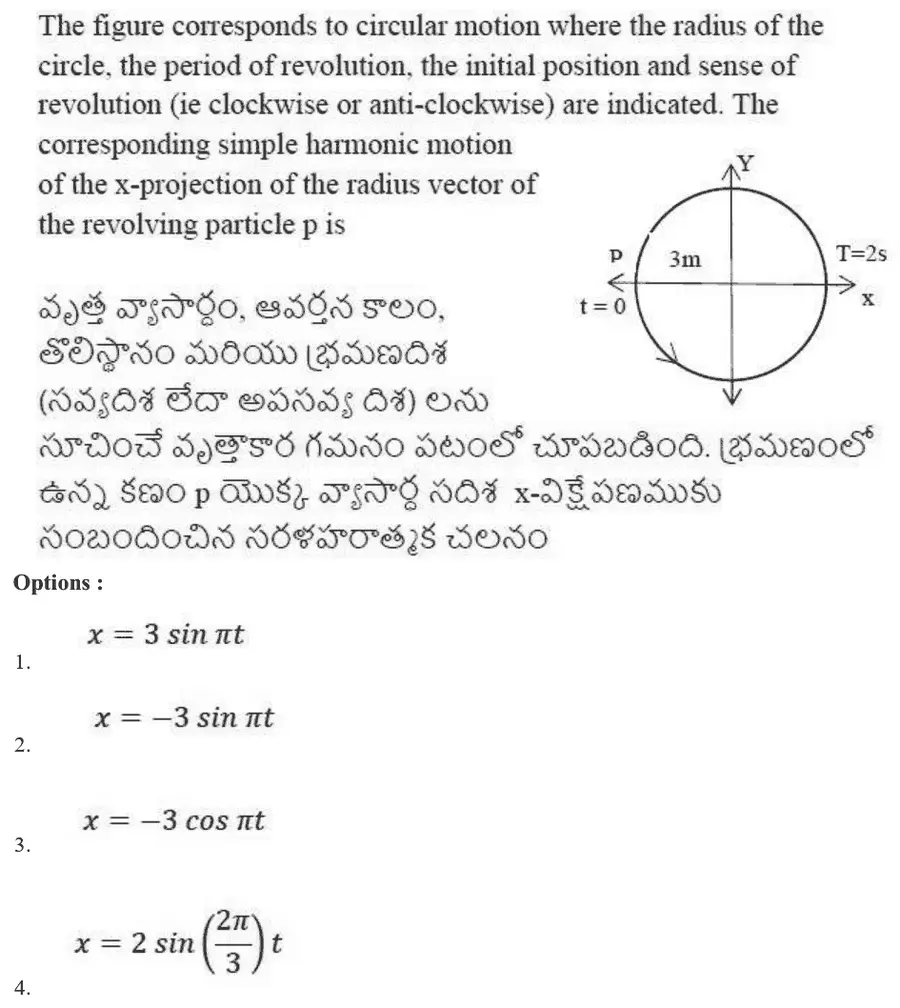
The figure corresponds to circular motion where the radius of the circle, the period of revolution, the initial position and sense of revolution (ie clockwise or anti-clockwise) are indicated. The corresponding simple harmonic motion of the x-projection of the radius vector of the revolving particle p is
A particle executes simple harmonic motion with an amplitude of 40 cm. If the time period of the particle is 6 s, then the minimum time taken by the particle to move from mean position to a point at a distance of 20 cm from the extreme position is
The amplitude of a damped harmonic oscillator becomes $\frac{1}{2\sqrt{2}}$ times its initial amplitude in a time of 6 s. Additional time taken for the amplitude to become $\frac{1}{4\sqrt{2}}$ times its initial amplitude is
Two particles A and B are executing simple harmonic motion with amplitudes 10 cm and 20 cm respectively. If the time periods of two particles A and B are 8 s and 12 s respectively, then the ratio of the times taken by the particles A and B to complete $\frac{1}{8}^{\text{th}}$ oscillation starting from their extreme positions is
The total energy of a particle executing simple harmonic motion with 2 cm amplitude is 160 mJ. The force acting on the particle at a point where the ratio of the potential and kinetic energies of the particle becomes 1 : 15 is
A circular disc of radius 15 cm and mass 10 kg is suspended by a wire attached to its centre. When the wire is twisted by rotating the disc and released, the period of torsional oscillations of the disc is 1.5 s. The torsional spring constant of the wire is nearly
For a particle executing simple harmonic motion, if the velocities at distances 6 cm and 8 cm from the mean position are $16\pi\ \mathrm{cms^{-1}}$ and $12\pi\ \mathrm{cms^{-1}}$ respectively, then the maximum acceleration of the particle (in $\mathrm{cms^{-2}}$) is
If the displacement of a particle executing simple harmonic motion is given by $x = 0.5\cos(125.6\,t)$, then the time period of oscillation of the particle is nearly
(Here $x$ is displacement in metre and $t$ is time in second)
The amplitude of a damped harmonic oscillator becomes 50% of its initial value in a time of 12 s. If the amplitude of the oscillator at a time of 36 s is x% of its initial amplitude, then the value of x is
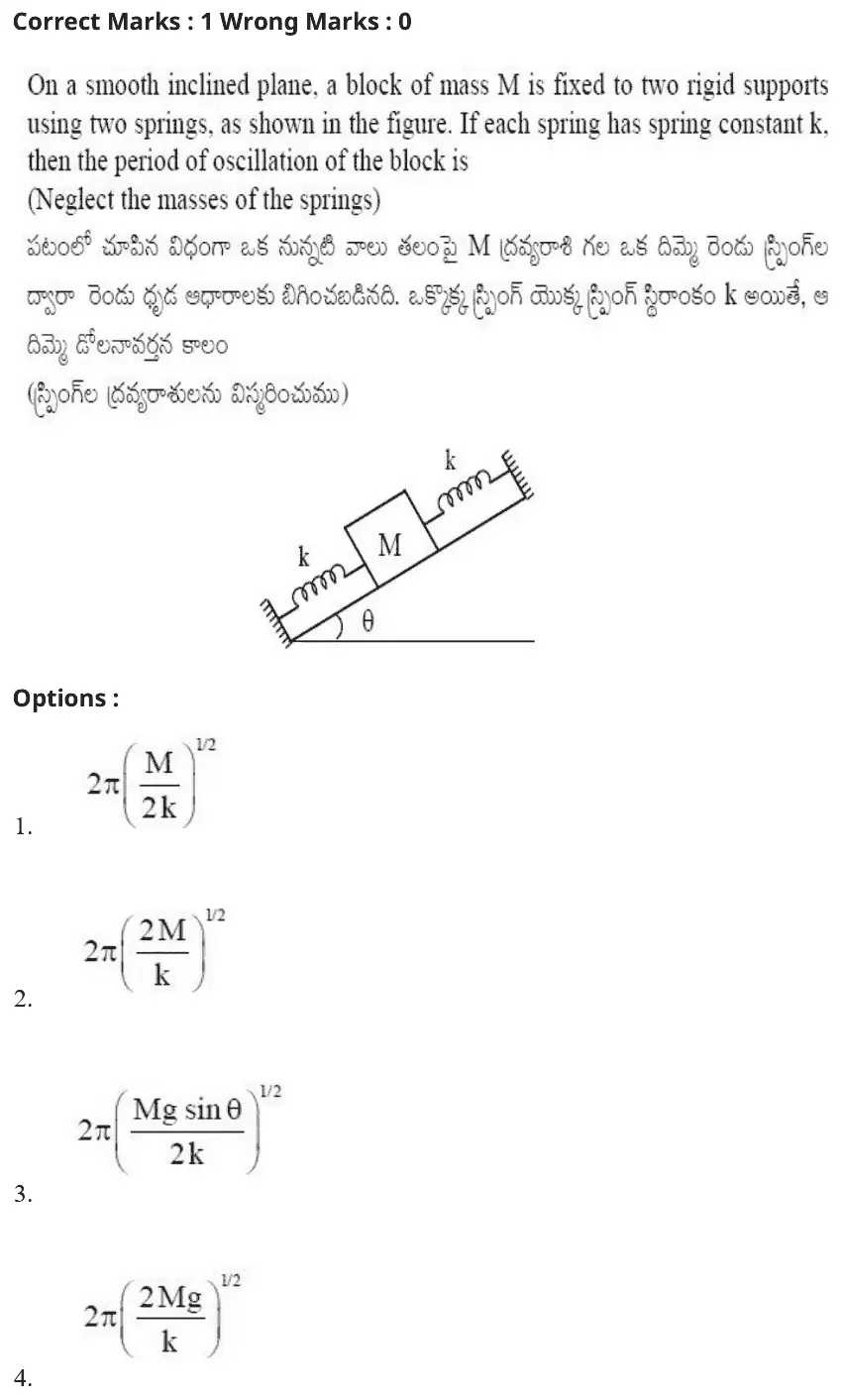
On a smooth inclined plane, a block of mass M is fixed to two rigid supports using two springs, as shown in the figure. If each spring has spring constant k, then the period of oscillation of the block is (Neglect the masses of the springs)
A particle is executing simple harmonic motion with amplitude A. The ratio of the kinetic energies of the particle when it is at displacements of $\frac{A}{4}$ and $\frac{A}{2}$ from the mean position is
The time period of a simple pendulum on the surface of the earth is T. If the pendulum is taken to a height equal to half of the radius of the earth, then its time period is
A particle is executing simple harmonic motion starting from its mean position. If the time period of the particle is 1.5 s, then the minimum time at which the ratio of the kinetic and total energies of the particle becomes $3 : 4$ is
A body of mass $4$ kg attached to a spring of force constant $64\ \mathrm{N\,m^{-1}}$ executes simple harmonic motion on a frictionless horizontal surface. The time period of oscillation is
A particle is executing simple harmonic motion with amplitude A. At a distance ‘x’ from the mean position, when the particle is moving towards extreme position it receives a blow in the direction of motion which instantaneously doubles its velocity. The new amplitude of the particle is (Frequency is constant during the motion)
The equations for the displacements of two particles in simple harmonic motion are $y_1 = 0.1\sin\left(100\pi t + \frac{\pi}{3}\right)$ and $y_2 = 0.1\cos\pi t$ respectively. The phase difference between the velocities of the two particles at a time $t = 0$ is
A spring is stretched by $0.2\ \mathrm{m}$ when a mass of $0.5\ \mathrm{kg}$ is suspended to it. The time period of the spring when $0.5\ \mathrm{kg}$ mass is replaced with a mass of $0.25\ \mathrm{kg}$ is suspended to it is (Acceleration due to gravity $= 10\ \mathrm{m\,s^{-2}}$)
For a particle executing simple harmonic motion, the ratio of kinetic and potential energies at a point where displacement is one half of the amplitude is
When the mass attached to a spring is increased from 4 kg to 9 kg, the time period of oscillation increases by $0.2\pi$ s. Then the spring constant of the spring is
If the maximum velocity and maximum acceleration of a particle executing simple harmonic motion are respectively $5\ \mathrm{m\ s^{-1}}$ and $10\ \mathrm{m\ s^{-2}}$, then the time period of oscillation of the particle is
A body of mass $1\ \mathrm{kg}$ is suspended from a spring of force constant $600\ \mathrm{N\,m^{-1}}$. Another body of mass $0.5\ \mathrm{kg}$ moving vertically upwards hits the suspended body with a velocity of $3\ \mathrm{m\,s^{-1}}$ and embedded in it. The amplitude of motion is
If the displacement y (in cm) of a particle executing simple harmonic motion is given by the equation $y=5\sin(3\pi t)+5\sqrt{3}\cos(3\pi t)$, then the amplitude of the particle is
The kinetic energy of a particle executing simple harmonic motion at a displacement of 3 cm from the mean position is 4 mJ. If the amplitude of the particle is 5 cm, then the maximum force acting on the particle is
A body of mass 1 kg is attached to the lower end of a vertically suspended spring of force constant 600 N m$^{-1}$. If another body of mass 0.5 kg moving vertically upward hits the suspended body with a velocity 3 m s$^{-1}$ and embedded in it, then the frequency of the oscillation is
If the amplitudes of a damped harmonic oscillator at times $t=0$, $t_1$ and $t_2$ are $A_0$, $A_1$ and $A_2$ respectively, then the amplitude of the oscillator at a time of $(t_1+t_2)$ is
The force (F in newton) acting on a particle of mass 90 g executing simple harmonic motion is given by $F+0.04\pi^2 y=0$, where $y$ is displacement of the particle in meter. If the amplitude of the particle is $\frac{6}{\pi}$ m, then the maximum velocity of the particle is
If the amplitude of a damped harmonic oscillator becomes half of its initial amplitude in a time of 10 s, then the time taken for the mechanical energy of the oscillator to become half of its initial mechanical energy is
At a given place, to increase the number of oscillations made by a simple pendulum in one minute from 72 to 90, the length of the pendulum is to be decreased by
The amplitude of a particle executing simple harmonic motion is 6 cm. The distance of the point from the mean position at which the ratio of the potential and kinetic energies of the particle becomes 4:5 is
A particle is executing simple harmonic motion. If the force acting on the particle at a position is 86.6% of the maximum force on it, then the ratio of its velocity at that point and its maximum velocity is
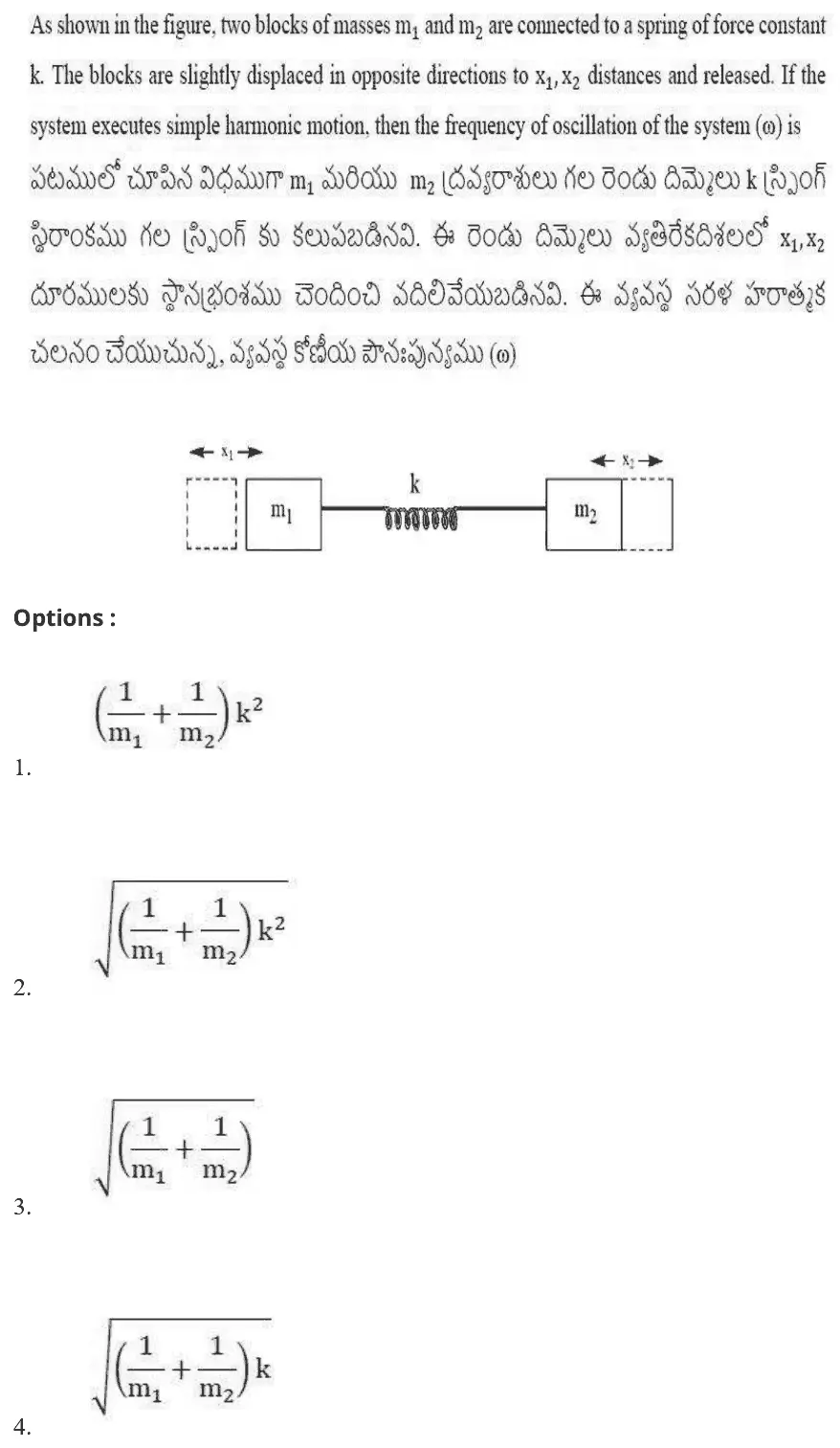
As shown in the figure, two blocks of masses $m_1$ and $m_2$ are connected to a spring of force constant k. The blocks are slightly displaced in opposite directions to $x_1, x_2$ distances and released. If the system executes simple harmonic motion, then the frequency of oscillation of the system ($\omega$) is
A mass M, attached to a horizontal spring executes simple harmonic motion with amplitude $A_1$. When mass M passes mean position then a smaller mass m is attached to it and both of them together executing simple harmonic motion with amplitude $A_2$. Then the value of $\frac{A_1}{A_2}$ is
Two simple harmonic motions are represented by $y_1 = 5\left[\sin 2\pi t + \sqrt{3}\cos 2\pi t\right]$ and $y_2 = 5\sin\left[2\pi t + \frac{\pi}{4}\right]$. The ratio of their amplitudes is
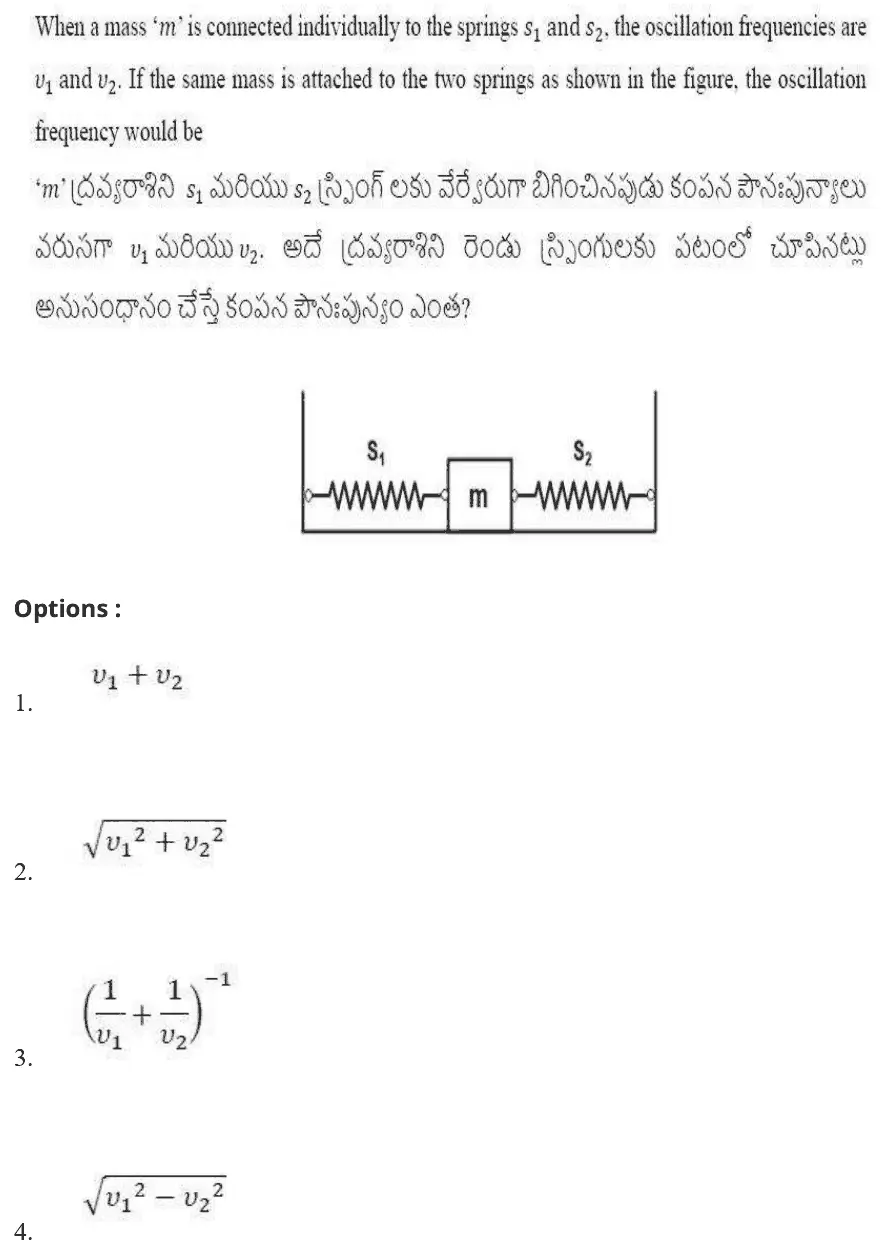
When a mass ‘m’ is connected individually to the springs $s_1$ and $s_2$, the oscillation frequencies are $v_1$ and $v_2$. If the same mass is attached to the two springs as shown in the figure, the oscillation frequency would be
The displacement of a particle of mass 2 g executing simple harmonic motion is $x = 8\cos\left(50t + \frac{\pi}{12}\right)$ m, where t is time in second. The maximum kinetic energy of the particle is
The relation between the force (F in newton) acting on a particle executing simple harmonic motion and the displacement of the particle ($y$ in metre) is $500F + \pi^2 y = 0$. If the mass of the particle is 2 g, the time period of oscillation of the particle is
The mass of a particle is 1 kg and it is moving along $x$-axis. The period of its oscillation is $\frac{\pi}{2}$. Its potential energy at a displacement of 0.2 m is
A body is executing simple harmonic motion. At a displacement 'x' its potential energy is $E_1$ and at a displacement 'y' its potential energy is $E_2$. The potential energy E at a displacement $(x + y)$ is
In a time of 2 s, the amplitude of a damped oscillator becomes $\frac{1}{e}$ times its initial amplitude A. In the next two seconds, the amplitude of the oscillator is
A particle is executing simple harmonic motion with a time period of 3 s. At a position where the displacement of the particle is 60% of its amplitude, the ratio of the kinetic and potential energies of the particle is
A horizontal board is performing simple harmonic oscillations horizontally with an amplitude 0.3 m and a period of 4 s. The minimum coefficient of friction between a heavy body placed on the board if the body is not to slip is.
A test tube of mass $6\ \mathrm{g}$ and uniform area of cross section $10\ \mathrm{cm}^2$ is floating in water vertically when $10\ \mathrm{g}$ of mercury is in the bottom. The tube is depressed by a small amount and then released. The time period of oscillation is (Accelaration due to gravity = $10\ ms^{-2}$)
The displacement of a particle executing simple harmonic motion is $y = A\sin(2t + \phi)$ m, where t is time in second and $\phi$ is phase angle. At time $t = 0$, the displacement and velocity of the particle are 2 m and $4\ \mathrm{ms^{-1}}$. The phase angle, $\phi =$
The displacement of a damped oscillator is $x(t) = \exp(-0.2t)\cos(3.2t + \emptyset)$ where t is time in second. The time required for the amplitude of the oscillator to become $\frac{1}{e^{1.2}}$ times its initial amplitude is
For a particle executing simple harmonic motion, match the following statements (conditions) from column I to statements (shapes of graph) in column II
A massless spring of length '$l$' and spring constant 'k' oscillates with a time period 'T' when loaded with a mass 'm'. The spring is now cut into three equal parts and are connected in parallel. The frequency of oscillation of the combination when it is loaded with a mass '4m' is
If a body dropped freely from a height of 20 m reaches the surface of a planet with a velocity of $31.4\ \mathrm{ms^{-1}}$, then the length of a simple pendulum that ticks seconds on the planet is
A block kept on a frictionless horizontal surface is connected to one end of a horizontal spring of constant $100\ \mathrm{Nm^{-1}}$ whose other end is fixed to a rigid vertical wall. Initially the block is at its equilibrium position. The block is pulled to a distance of 8 cm and released. The kinetic energy of the block when it is at a distance of 3 cm from the mean position is
In a time ‘t’, the amplitude of vibrations of a damped oscillator becomes half of its initial value, then the mechanical energy of the oscillator decreases by
A particle of mass 4 mg is executing simple harmonic motion along x-axis with an angular frequency of 40 rad s$^{-1}$. If the potential energy of the particle is $V(x) = a + bx^2$, where $V(x)$ is in joule and x is in metre, then the value of b is
A pendulum of time period one second is losing its mechanical energy due to damping. Its mechanical energy at time t = 0 is 45 J. After completing 15 oscillations, its mechanical energy is 15 J. The ratio of the damping constant and the mass of the object making damped oscillations is
The equation of motion of a particle executing simple harmonic motion is given by $x = 3\sin\left(6t + \frac{\pi}{6}\right)$, where $x$ is in metres and $t$ is in seconds. The ratio of the potential and kinetic energies of the particle at time $t = 0$ is
Two particles execute simple harmonic motion along the same straight line with same amplitude and same frequency. The two particles pass one another when moving in opposite directions each time at a distance of $\frac{1}{\sqrt{2}}$ times the amplitude from their common mean position. The phase difference between the two particles is
The equation of motion of a particle executing simple harmonic motion is $4\frac{d^2y}{dt^2}+\pi^2 y=0$ where y is in metres and t is in seconds. The time period of oscillation of the particle is
A block of mass M hangs from a spring and oscillates vertically with an angular frequency $\omega$. If the block is removed from the spring, when it is in equilibrium position, the spring shortens by
The mechanical energy of a damped oscillator becomes half of its initial energy in 4 seconds. In another t seconds its mechanical energy becomes 12.5% of its initial mechanical energy. Then t =
When an external force with angular frequency $\omega_d$ acts on a system of natural angular frequency $\omega$, the system oscillates with angular frequency $\omega_d$. The condition for the amplitude of oscillations to be maximum is
A particle initially at the mean position is executing simple harmonic motion with an angular frequency $\frac{\pi}{4}$ rad s$^{-1}$. The ratio of the distances travelled by the particle in the first second and second second is
The time period of a simple pendulum on the surface of the earth is T. The height above the surface of the earth at which the time period of the pendulum becomes 2T is
When a body of mass 8 kg is attached to a spring balance, the reading of the balance is 20 cm. Instead of 8 kg, if another body of mass M is suspended from the spring balance and is made to oscillate vertically, the time period of oscillation is $\frac{\pi}{5}$ s, then the value of M is
(Acceleration due to gravity = $10\ \mathrm{ms^{-2}}$)
Under the action of a force $F = -75y$ where $F$ is in Newton and $y$ is in meters, an object of mass 3 kg executes simple harmonic motion. If the velocity of the object at the mean position is $2.5\ \mathrm{ms^{-1}}$, the maximum acceleration of the object is
A particle is executing simple harmonic motion. If the minimum time taken by the particle to move from extreme position to half of the amplitude is $t_1$, and the minimum time taken by the particle to move from mean position to half of the amplitude is $t_2$, then
The time taken for the amplitude of vibrations of a damped oscillator to drop to 25% of its initial value is t. The time taken for its mechanical energy to drop to 50% of its initial mechanical energy is
The amplitudes of a damped harmonic oscillator after 2 and 4 seconds are $A_1$ and $A_2$ respectively. If the initial amplitude of the oscillator is $A_0$, then
An object of mass 3 kg is executing simple harmonic motion with an amplitude $\frac{2}{\pi}$ m. If the kinetic energy of the object when it crosses the mean position is 6 J, the time period of oscillation of the object is
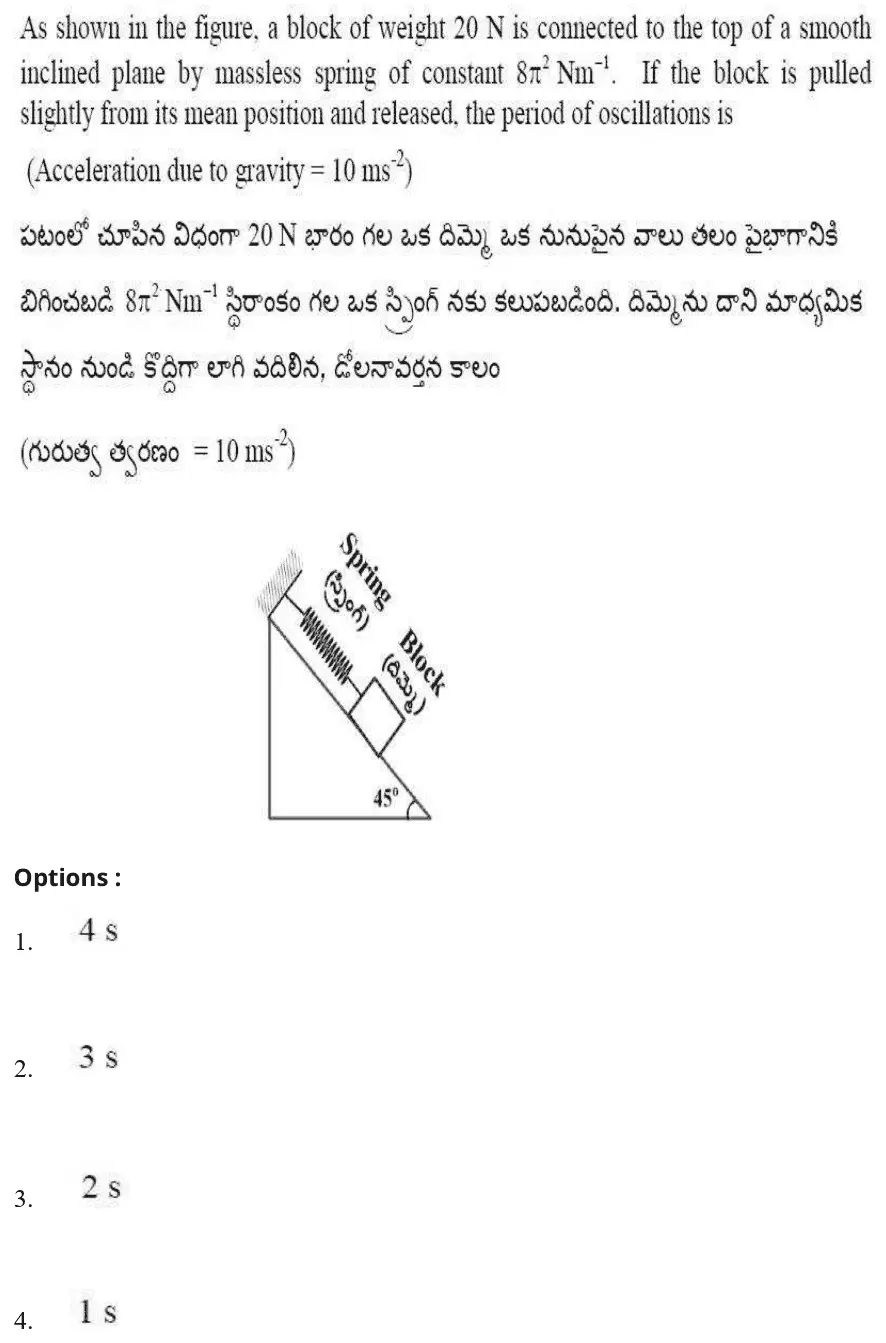
As shown in the figure, a block of weight 20 N is connected to the top of a smooth inclined plane by massless spring of constant $8\pi^2\ \mathrm{Nm^{-1}}$. If the block is pulled slightly from its mean position and released, the period of oscillations is
(Acceleration due to gravity = $10\ \mathrm{ms^{-2}}$)
The displacement of a particle executing simple harmonic motion is given by $x = 2\cos(t)$ where t is the time in seconds then the time period of the particle is
A pendulum has a time period T in air. When it is made to oscillate in water its time period is $\sqrt{2}\,T$. Then the relative density of the material of the bob of the pendulum is (neglect damping)
A force of 6.4 N stretches a vertical spring by 0.1 m. If it were to oscillate with a period of $\frac{\pi}{4}$ then the mass that is to be suspended from the spring is
For a particle executing simple harmonic motion, the kinetic energy of the particle at a distance of 4 cm from the mean position is $\frac{1}{3}$rd of the maximum kinetic energy. The amplitude of the motion is
A clock is designed based on the oscillations of a spring-block system suspended vertically in the absence of air-resistance. Assume it shows the correct time when a spring of stiffness 'k' and block of mass 'm' are used. If the block is replaced by another block of mass 4m, choose the correct option
A particle performs Simple harmonic motion with a time period of 16s. At a time t = 2s, the particle passes through the origin and at t = 4s its velocity is 4 m/s. The amplitude of the motion is
A block is in simple harmonic motion (S.H.M) on the end of the spring with position given by $x=(5)\cos\left(\omega t+\dfrac{\pi}{4}\right)$ cm. If the total mechanical energy used is 100 J to achieve maximum displacement, then the potential energy at time $t=0$ is
A simple pendulum of length 1 m and having a bob of mass 100 g is suspended in a car, moving on a circular track of radius 100 m with uniform speed 10 m/s. If the pendulum makes small oscillation in a radial direction about its equilibrium position, then its time period can be given by $T=2\pi\,/\,\alpha^{1/4}$. The value of $\alpha$ is [Take g = 10 m/s$^2$]
The amplitude of a damped oscillator varies with time as $A(t)=A_{o}\exp(-bt/2m)$ where $b=70$ g/s and $m=200$ g. How long does it take for the mechanical energy to drop to one – fourth of its initial value? [ Take $\ln2=0.7$]
A body starting at t = 0 from origin and oscillates simple harmonically with a period of 4s. After what time will its kinetic energy be 75% of its total energy
A simple pendulum consists of a small sphere of mass ‘m’ suspended by a thread of length ‘$l$’. The sphere carries a positive charge q. The pendulum is allowed to do small oscillations in a uniform electric field E with direction vertically upwards. The time period of oscillation is
A solid sphere of mass M and radius R is attached to a spring of negligible mass kept on a horizontal plane such that it can roll without slipping. The sphere is made to execute SHM by stretching through a distance and released, then the time period of such oscillation is (K = spring constant)
Position of a 2 kg mass moving along the x-axis is given by $x = 2\cos\left[(2\ \mathrm{s^{-1}})\,t\right]$ m. Then maximum kinetic energy of the mass in joule is
An object mass 2 kg is attached to a spring with spring constant $8\ \mathrm{Nm^{-1}}$. If the object is executing simple harmonic motion then the number of cycles it completes in 66 s is
Position of a 3 kg mass moving along the x-axis is given by $x = 0.3\cos(\omega t)$ m. If K (t) denotes the kinetic energy at time t, Then the value of $\dfrac{K\left(\frac{\pi}{6\omega}\right)}{K\left(\frac{\pi}{3\omega}\right)}$ is
Assertion (A): In S.H.M kinetic and potential energy become equal when the distance is $\frac{1}{\sqrt{2}}$ times its amplitude Reason (R): The potential energy of a particle executing S.H.M is periodic with time period being maximum at the extreme displacement.
A
(A) and (R) are true. R is correct explanation of A
B
(A) and (R) are true. R is not correct explanation of A
A block of mass 100 g is connected to an elastic spring of spring constant $450\ \mathrm{Nm^{-1}}$ oscillates vertically. The block-spring system is in viscous surrounding medium with a damping constant $69.3\ \mathrm{g\,s^{-1}}$. The time in which the amplitude of oscillations drop to half of its initial value. [take $\ln 2 = 0.693$]
A point mass of 400 g executes S.H.M. under a force $F = -(10\ \mathrm{Nm^{-1}})\,x$. If it crosses the centre of oscillation with a speed of $10\ \mathrm{ms^{-1}}$, the amplitude of motion is
A particle executes simple harmonic motion with a time period 0.6 s and amplitude 10 cm. Then the mean velocity of the particle over the time interval during which it travels a distance 5 cm starting from the equilibrium position.
A point mass oscillates along x-axis according to $x = x_o \sin\left(\omega t - \frac{\pi}{6}\right)$. If the acceleration of the point mass is written as $a = A\sin(\omega t + \delta)$ then
A particle undergoing simple harmonic motion has an amplitude of 10 cm. When the particle is at a displacement of 6 cm from the center, then the ratio of its kinetic energy to potential energy is
An object is executing simple harmonic motion with an angular frequency $\omega$. If the maximum velocity is $v_{\max}$ then the maximum acceleration of the object is
A particle is executing simple harmonic motion with an instantaneous displacement $x = A\sin^2\left(\omega t - \frac{\pi}{4}\right)$. The time period of oscillation of the particle is
A pendulum is oscillating at a frequency of 8 Hz. Suddenly the string of the pendulum is clamped at its midpoint then the new frequency of oscillations is
Time period of a simple pendulum is 4 s at a place on the earth where the acceleration due to gravity is $\pi^2\ \mathrm{ms^{-2}}$. Then the length of the pendulum in meters is
A hydrometer executes simple harmonic motion when it is pushed down vertically in a liquid of density $\rho$. If the mass of hydrometer is m and the radius of the hydrometer tube is r, then the time period of oscillation is
An object undergoing simple harmonic motion takes 0.5 s to travel from one point of zero velocity to the next such point. The angular frequency of the motion is
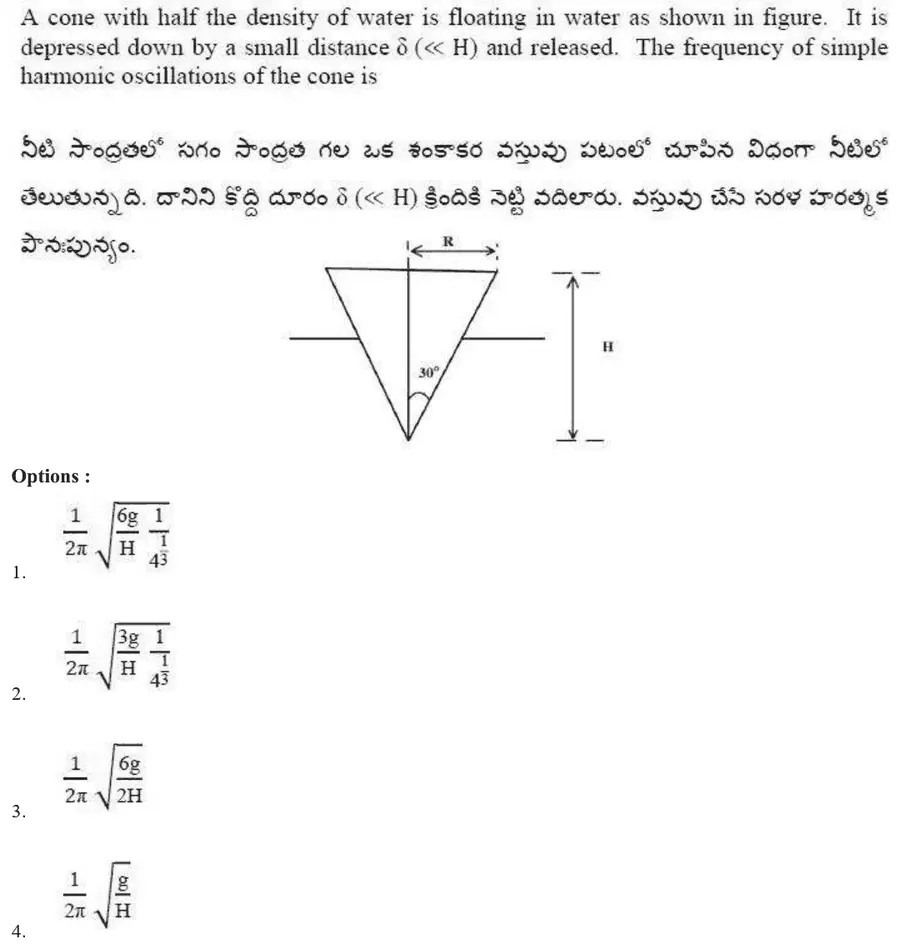
A cone with half the density of water is floating in water as shown in figure. It is depressed down by a small distance $\delta$ ($\ll$ H) and released. The frequency of simple harmonic oscillations of the cone is (see the figure above)
A body is executing S.H.M. At a displacement 'x' its potential energy is 9 J and at a displacement 'y' its potential energy is 16 J. The potential energy at displacement (x+y) is
The time period of a pendulum in a stationary lift is 'T'. If the lift moves upwards with acceleration $\frac{g}{6}$, the time period of the pendulum becomes ______
Match the following entries in column-I and column-II with respect to an oscillating spring-block system: Column-I a) Mass of the block is doubled b) Spring constant is made 4 times c) Amplitude of oscillations is doubled d) Angular frequency is doubled Column-II i) Energy of oscillation becomes 4 times ii) Speed of block becomes 2 times iii) P.E. becomes 4 times iv) Time period becomes $\sqrt{2}$ times
A particle of mass $0.4\ \mathrm{kg}$ executes simple harmonic motion of amplitude $0.4\ \mathrm{m}$. When it passes through the mean position, its kinetic energy is $256 \times 10^{-3}\ \mathrm{J}$. If the initial phase of the oscillation is $\frac{\pi}{4}$, then the equation of its motion is ______
A particle executing simple harmonic motion has a maximum speed of $40\ \mathrm{m.s^{-1}}$ and maximum acceleration of $60\ \mathrm{m.s^{-2}}$. The period of oscillation is ______
Two particles 'P' and 'Q' describe SHM of same amplitude 'a' and same frequency 'f' along the same straight line. The maximum distance between the two particles is $a\sqrt{2}$. The phase difference between the particle is ______
A simple pendulum, suspended from the ceiling of a lift, has a period of oscillation $T$, when the lift is at rest. If the lift starts moving upwards with an acceleration $a = 3g$, then the new period will be
A body of mass $4.9\ kg$ hangs from a spring and oscillates with a period $0.5\ s$. On the removal of the body, the spring is shortened by ______ (Take $g = 10\ m.s^{-2}, \pi^{2} = 10$)
The amplitude of a damped oscillator is known to decrease to 0.9 times its original magnitude in 5 seconds. Approximately, by how many times its original magnitude will its amplitude decrease after another 20 seconds?
A particle executing simple harmonic motion along a straight line with an amplitude $A$, attains maximum potential energy when its displacement from mean position equals ______.
The bob of a simple pendulum is a spherical hollow ball filled with water. A plugged hole near the bottom of the oscillating bob gets suddenly unplugged. During observation, till water is coming out, the time period of oscillation would:
A
remain unchanged
B
increase towards a saturation value
C
first increase and then decrease to the original value.
D
first decrease and then increase to the original value.
Two waves are represented by: $x_1 = A\sin\left(\omega t + \frac{\pi}{6}\right)$ and $x_2 = A\cos\omega t$ Then the phase difference between them is ______
A spring is stretched by $0.40\ m$ when a mass of $0.6\ kg$ is suspended from it. The period of oscillations of the spring loaded by $255\ gm$ and put to oscillations is close to ______ (g = $10\ \mathrm{m.s^{-2}}$)
A heavy brass sphere is hung from a spring and it executes vertical vibrations with period $T$. The sphere is now immersed in a non-viscous liquid with a density $(1/10)^{th}$ that of brass. When set into vertical vibrations with the sphere remaining inside liquid all the time, the time period will be
A block of mass $1\ \mathrm{kg}$ is fastened to a spring of spring constant of $100\ \mathrm{N.m^{-1}}$. The block is pulled to a distance $x = 10\ \mathrm{cm}$ from its equilibrium position ($x = 0\ \mathrm{cm}$) on a frictionless surface, from rest at $t = 0$. The kinetic energy and the potential energy of the block when it is $5\ \mathrm{cm}$ away from the mean position is ______
The scale of a spring balance which can measure from 0 to $15\ \mathrm{kg}$ is $0.25\ \mathrm{m}$ long. If a body suspended from this balance oscillates with a time period $\dfrac{2\pi}{5}$ seconds, neglecting the mass of the spring, find the mass of the body suspended.
A particle executes simple harmonic motion according to the equation $x(t)=A\sin^2(\alpha t)$. If the time period of the S.H.M is 0.2 s, then the value of $\alpha$ (in units of rad/s) is
Two particles execute simple harmonic motion (SHM) along close parallel lines. SHM of the both the particles have same frequency and same amplitude. When they pass each other moving in opposite direction each time, their displacement is half their amplitude. Then their phase difference is
The displacement of a particle in simple harmonic motion (SHM) is given by $y=\sqrt{3\pi}\sin\left(\frac{100}{\pi}t+\frac{\pi}{4}\right)$. What will be the displacement of the particle from the mean position when its kinetic energy is eight times that of its potential energy?
A simple harmonic oscillator has an amplitude of 0.5 m and a time period of 2 seconds. What is the magnitude of acceleration when it is displaced from the mean position by 0.25 m?
A body of mass 1 kg is executing simple harmonic motion (SHM). Its displacement y (in cm) at time t given by $y = \left[6\sin\left(100t+\frac{\pi}{4}\right)\right]$ cm. Its maximum kinetic energy is
A particle is executing simple harmonic motion (SHM). Its acceleration at a distance of 1 cm from the mean position is $3\ \mathrm{cm/s^2}$. If its velocity is 6 cm/s when it is at a distance of 2 cm from its mean position, then the amplitude of SHM is
A particle executes simple harmonic motion between $x = -A$ and $x = +A$. If it takes a time $T_1$ to go from $x = 0$ to $x = A/2$ and $T_2$ to go from $x = A/2$ to $x = A$. Then
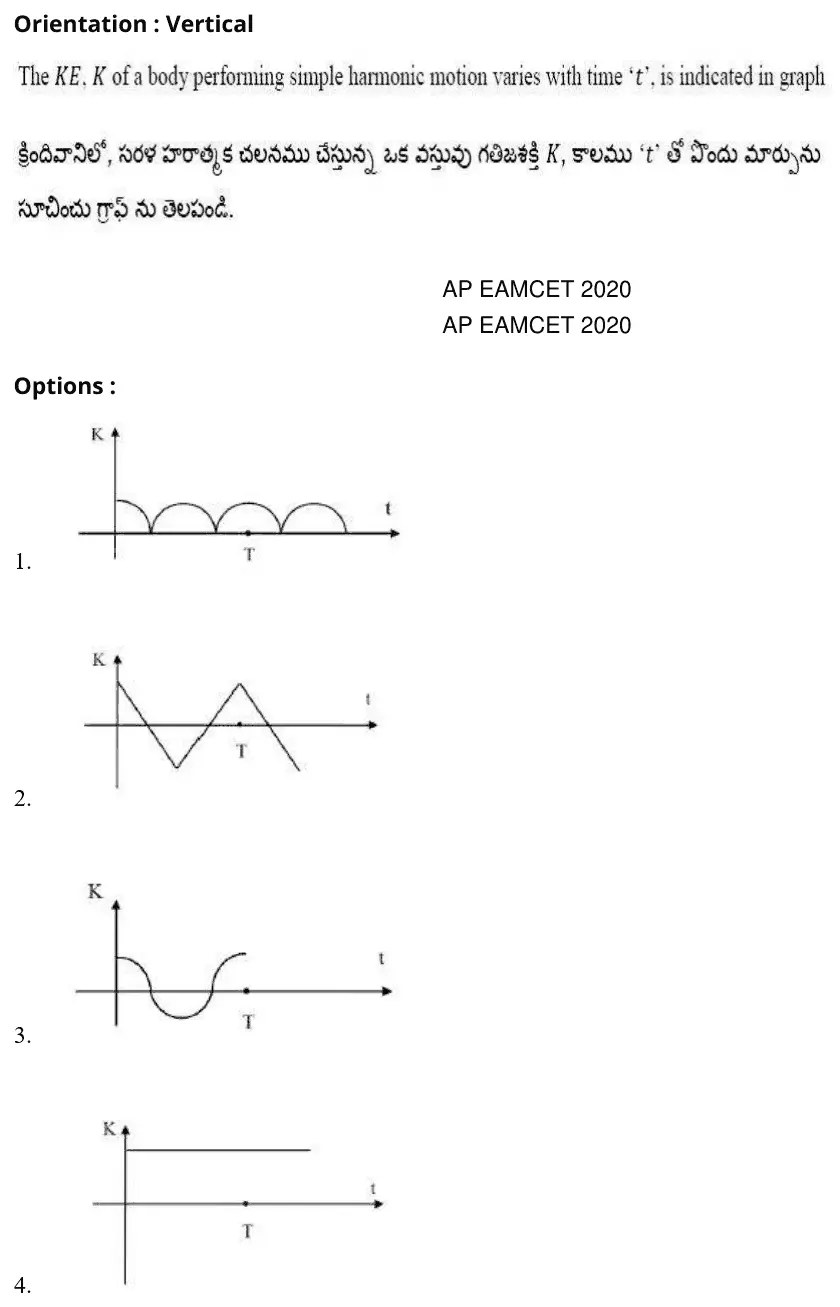
The $KE$, $K$ of a body performing simple harmonic motion varies with time 't', is indicated in graph
The question as printed in the paper.
A
see figure K vs t graph: a series of positive arches (rectified-sine-like humps) all above the t axis, touching zero between them, four humps shown
B
see figure K vs t graph: triangular zig-zag wave starting at a positive value at t=0, falling linearly below the t axis to a minimum, rising to a peak above the axis near T, then falling again below the axis
C
see figure K vs t graph: smooth curve starting positive at t=0, dipping below the t axis to a minimum, then rising back up to a peak above the axis near T
D
see figure K vs t graph: a constant horizontal line above the t axis
The maximum velocity of a particle performing simple harmonic motion is 6.28 $\mathrm{cm.s^{-1}}$. If the length of its path is 8 $\mathrm{cm}$, what is its period?
The maximum force acting on a particle executing simple harmonic motion is $10\ \mathrm{N}$. The force on the particle when it is midway between mean and extreme positions will be
A body executes simple harmonic motion with an amplitude $A$. At what displacement, from the mean position, is the potential energy of the body one fourth of its total energy?
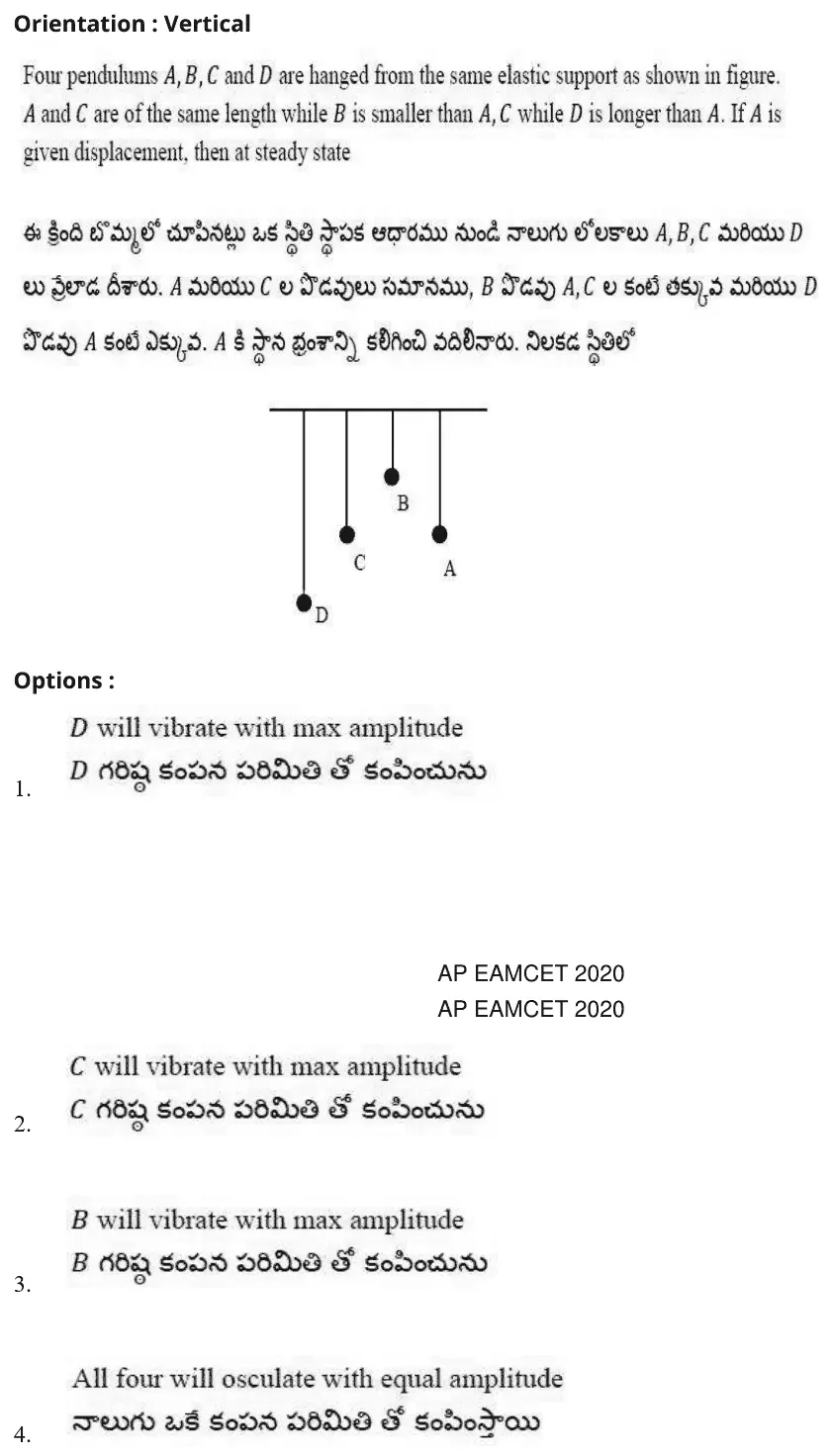
Four pendulums $A, B, C$ and $D$ are hanged from the same elastic support as shown in figure. $A$ and $C$ are of the same length while $B$ is smaller than $A, C$ while $D$ is longer than $A$. If $A$ is given displacement, then at steady state (see the figure above)
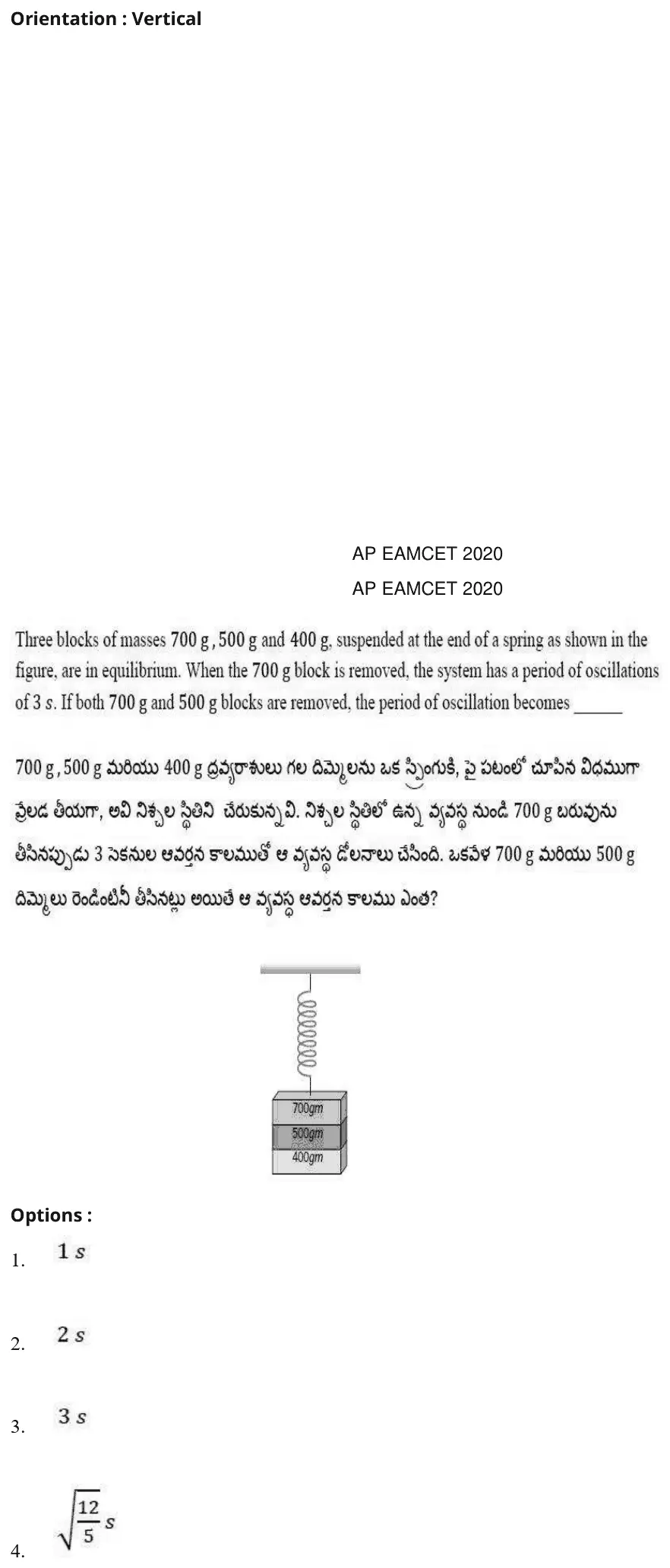
Three blocks of masses $700\ \mathrm{g}$, $500\ \mathrm{g}$ and $400\ \mathrm{g}$, suspended at the end of a spring as shown in the figure, are in equilibrium. When the $700\ \mathrm{g}$ block is removed, the system has a period of oscillations of $3\ s$. If both $700\ \mathrm{g}$ and $500\ \mathrm{g}$ blocks are removed, the period of oscillation becomes ______ (see the figure above)
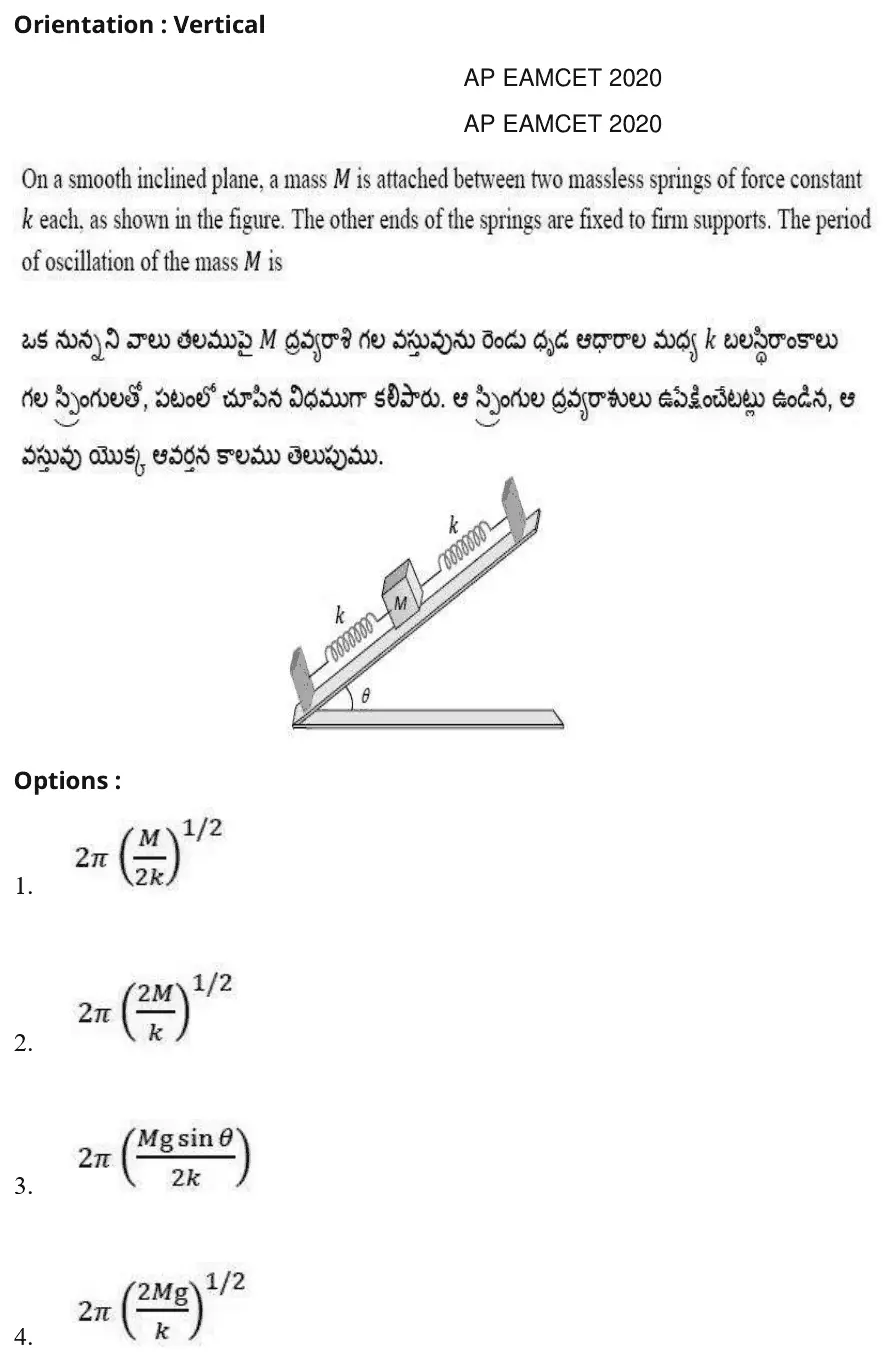
On a smooth inclined plane, a mass $M$ is attached between two massless springs of force constant $k$ each, as shown in the figure. The other ends of the springs are fixed to firm supports. The period of oscillation of the mass $M$ is (see the figure above)
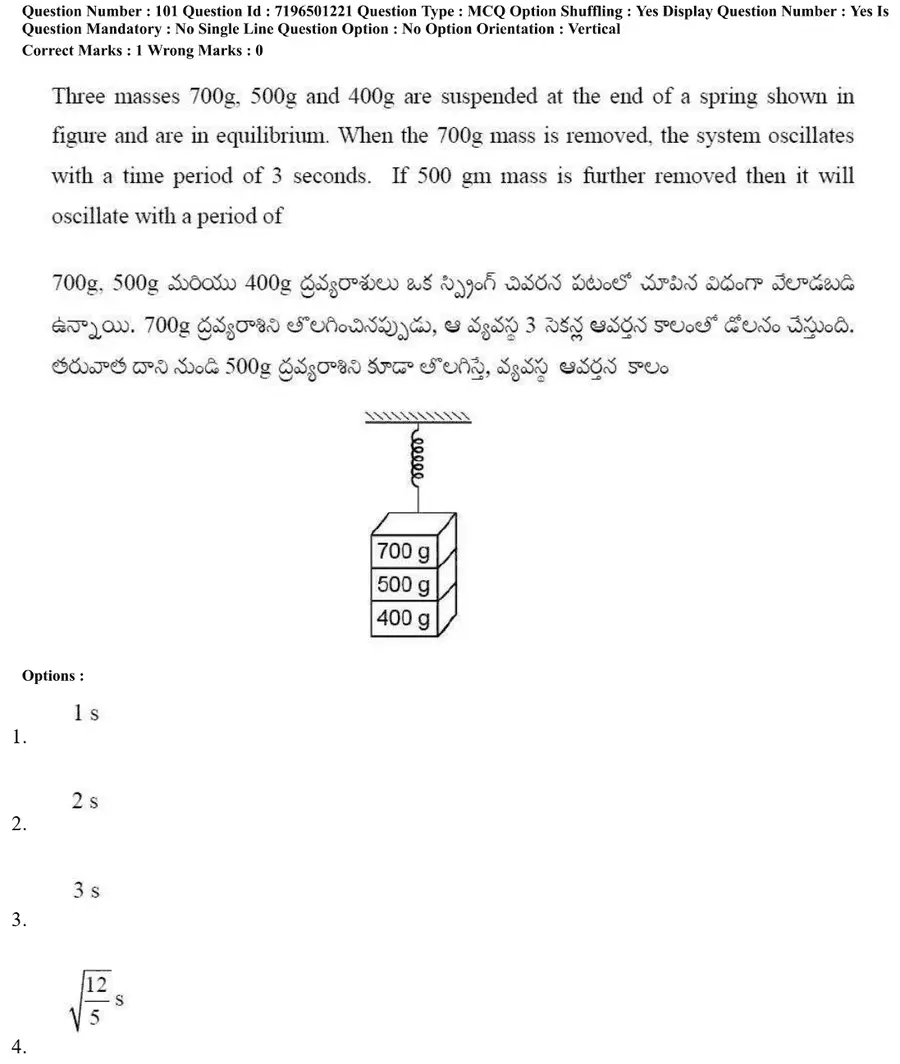
Three masses 700g, 500g and 400g are suspended at the end of a spring shown in figure and are in equilibrium. When the 700g mass is removed, the system oscillates with a time period of 3 seconds. If 500 gm mass is further removed then it will oscillate with a period of (see the figure above)
A particle is executing simple harmonic motion in one dimension. If the amplitude of oscillations is 0.2 cm and if its velocity at the mean position is $5\,m/s$, then the angular frequency of the oscillation is
A body is oscillating in simple harmonic motion according to the equation $x = 6\cos\left(2\pi t + \dfrac{\pi}{3}\right)$ meters. The magnitude of the acceleration (in $\mathrm{m/s^2}$) of the body at $t = 1\mathrm{s}$.
Consider a simple harmonic motion (SHM). Let K and U be kinetic energy and potential energy when the displacement in SHM is one -half $\left(\dfrac{1}{2}\right)$ the amplitude. The correct statement is
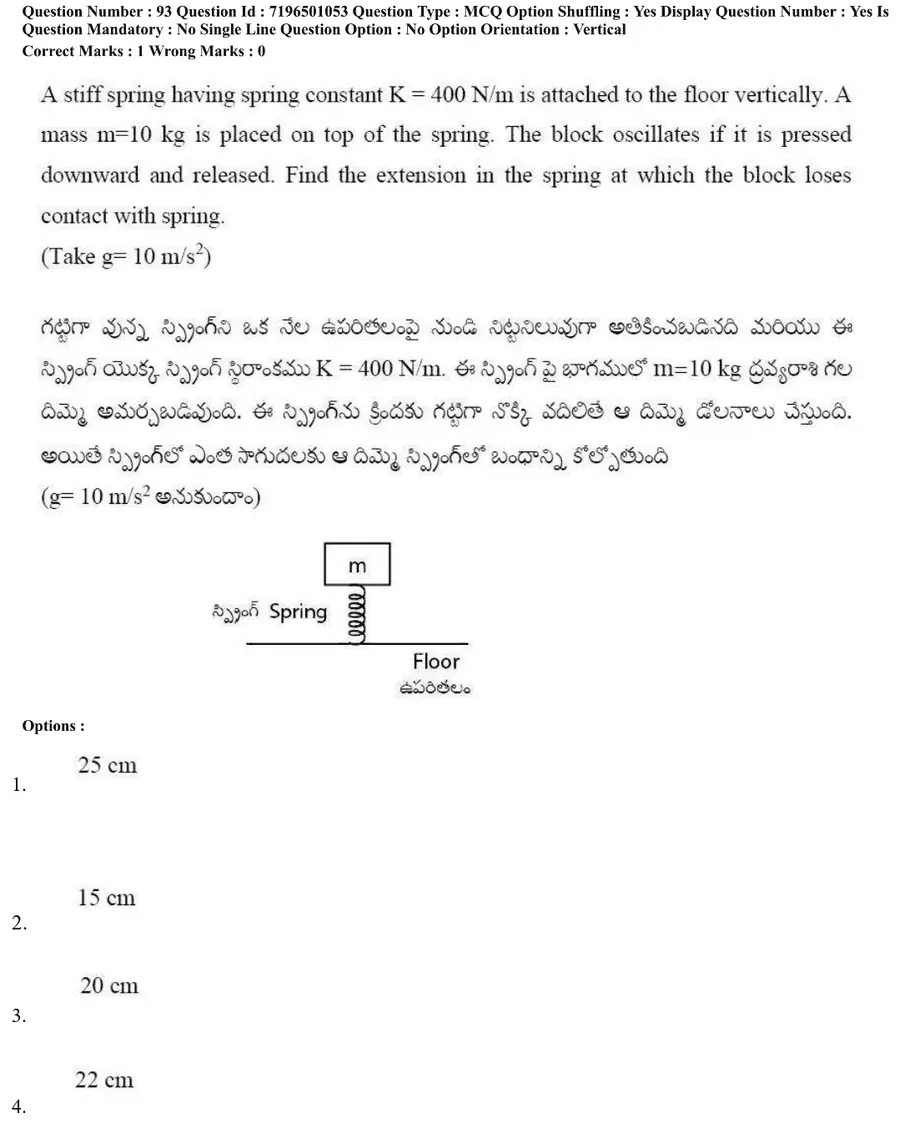
A stiff spring having spring constant K = 400 N/m is attached to the floor vertically. A mass m=10 kg is placed on top of the spring. The block oscillates if it is pressed downward and released. Find the extension in the spring at which the block loses contact with spring. (Take $g = 10\ \mathrm{m/s^2}$) (see the figure above)
For a particle executing SHM, determine the ratio of average acceleration of the particle between extreme position and equilibrium position w.r.t the maximum acceleration.
A point mass oscillates along the x-axis according to the law $x = x_0 \cos\left(\omega t - \frac{\pi}{4}\right)$. If the acceleration of the particle is written as $a = A\cos(\omega t - \delta)$, then
A simple harmonic oscillator of frequency 1 Hz has a phase of 1 radian. By how much should the origin be shifted in time so as to make the phase of the oscillator vanish. (time in seconds (s)).
A small sphere of radius r is placed as a concave surface of radius of curvature R a little away from the centre. When the sphere is released, it oscillates. Assuming the oscillation to be simple harmonic motion, and r << R then the time period is
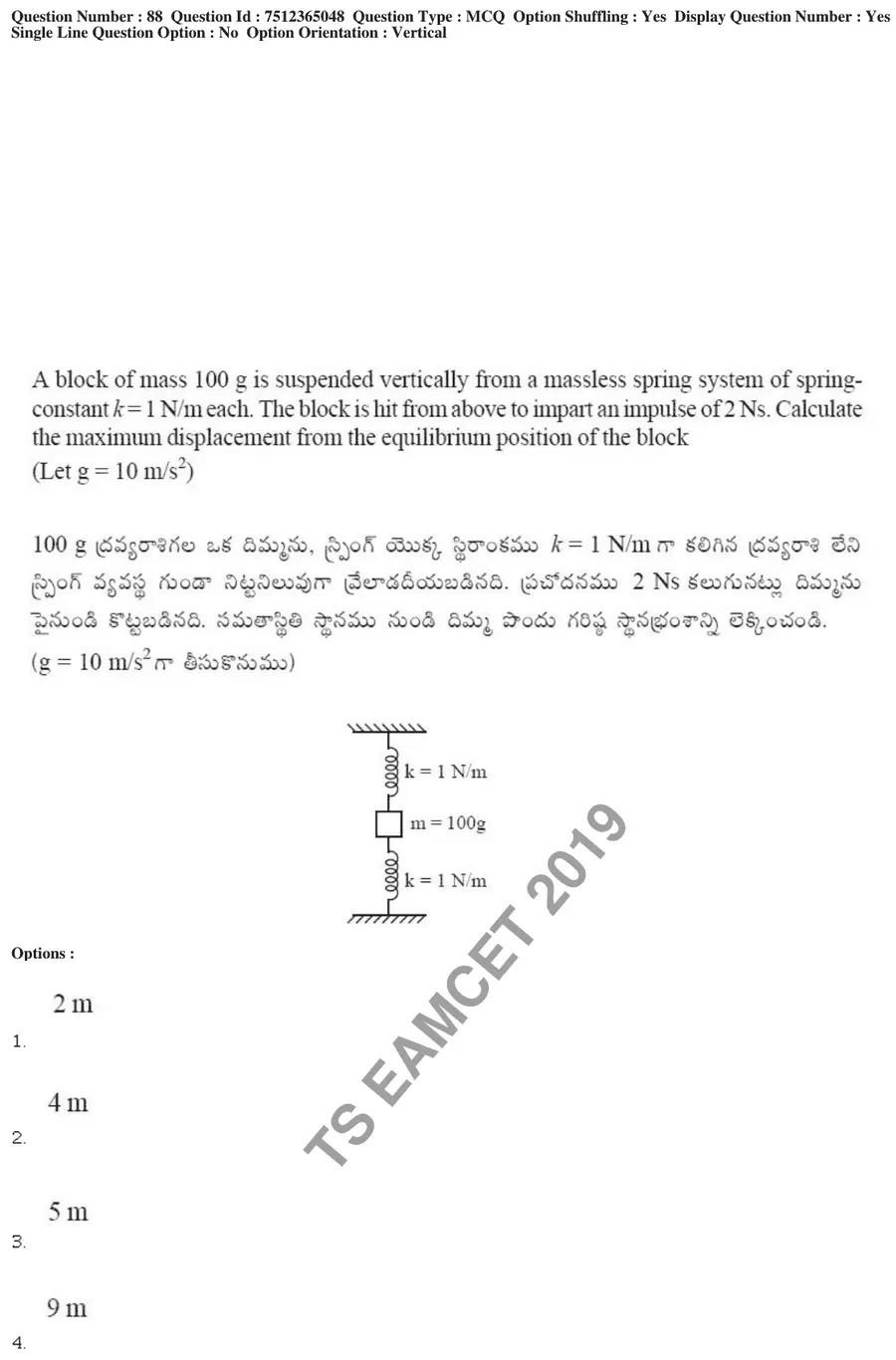
A block of mass 100 g is suspended vertically from a massless spring system of spring-constant $k = 1$ N/m each. The block is hit from above to impart an impulse of 2 Ns. Calculate the maximum displacement from the equilibrium position of the block (Let $g = 10$ m/s$^2$) (see the figure above)
A uniform rod of length 1.8 m suspended by an end is made to undergo small oscillations. Find the length of the simple pendulum having the mass and time period equal to that of the rod.
A body of mass 0.3 kg hangs by a spring with a force constant of 50 N/m. The amplitude of oscillations is damped and reaches $\frac{1}{e}$ of its original value in about 100 oscillations. If $\omega$ and $\omega'$ are the angular frequencies of undamped and damped oscillations respectively, then percentage of $\left(\frac{\omega - \omega'}{\omega}\right)$ is
Two particles executing simple harmonic motion as described by $y_1 = 30\sin\left(2\pi t + \frac{\pi}{3}\right)$ and $y_2 = 10(\sin 2\pi t + \sqrt{3}\cos 2\pi t)$ have amplitudes $A_1$ and $A_2$ respectively. The ratio $A_1 : A_2$ is
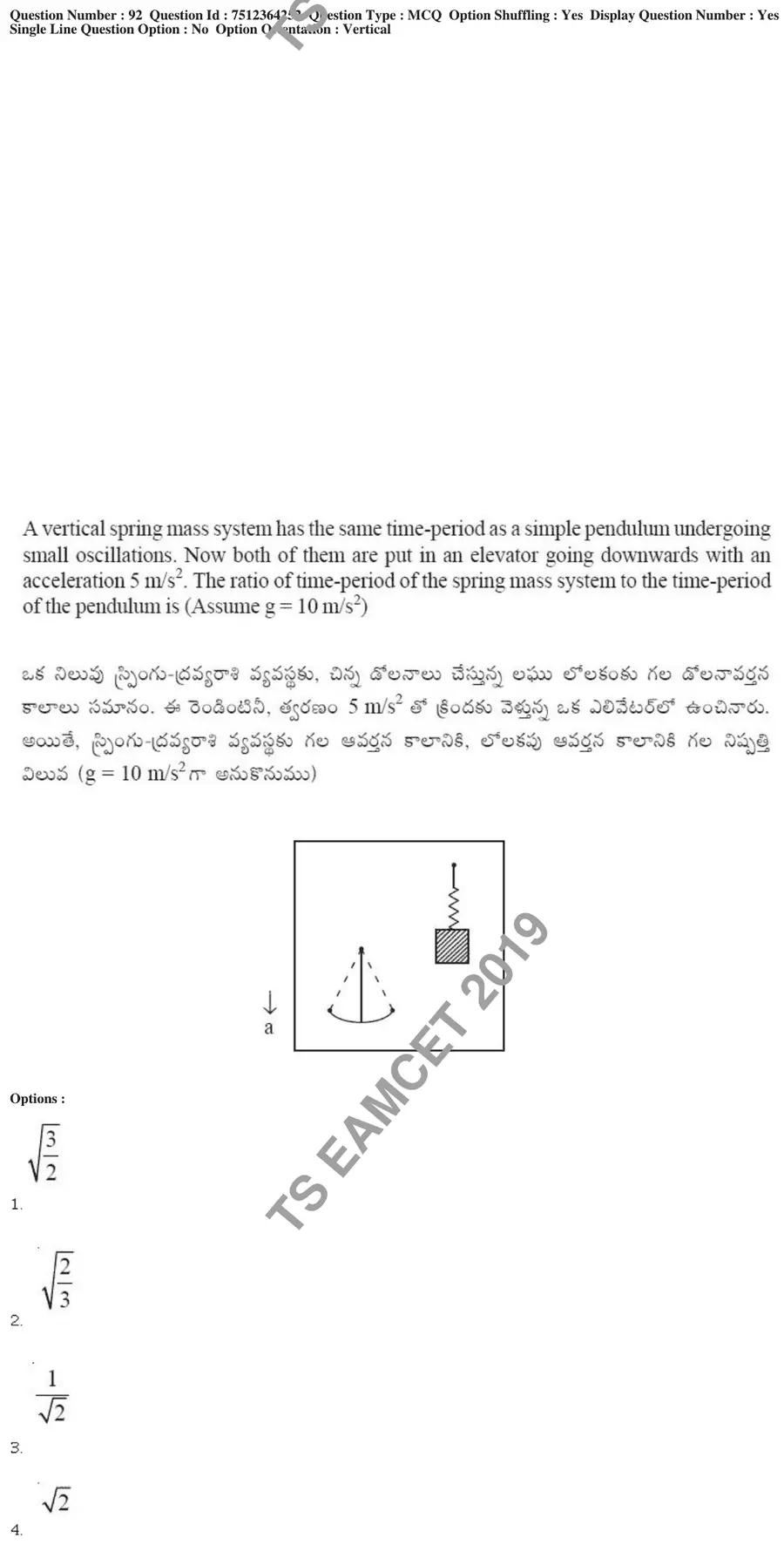
A vertical spring mass system has the same time-period as a simple pendulum undergoing small oscillations. Now both of them are put in an elevator going downwards with an acceleration $5\ \mathrm{m/s^2}$. The ratio of time-period of the spring mass system to the time-period of the pendulum is (Assume $g = 10\ \mathrm{m/s^2}$) (see the figure above)
A particle of mass 0.1 kg is executing simple harmonic motion of amplitude 0.1 m. When the particle passes through the mean position, its kinetic energy is $8\times10^{-3}$ J. If the initial phase is $45^\circ$, the equation of its motion is (Assume, $x(t)$ as the position of the particle at time $t$)
Which of the following equation represents a simple harmonic motion? ($\omega$ is angular frequency, A is amplitude of oscillation and $i = \sqrt{-1}$ )
A body of mass $1\ \mathrm{kg}$ is suspended from a spring of negligible mass. Another body of mass $500\ \mathrm{g}$ moving vertically upwards hits the suspended body with a velocity of $3\ \mathrm{ms^{-1}}$ and gets embedded in it. If the frequency of oscillation of the system of the two bodies after collision is $\frac{10}{\pi}\ \mathrm{Hz}$, the amplitude of motion and the spring constant are respectively
A particle executing SHM along a straight line has zero velocity at points A and B whose distances from 'O' on the same line OAB are '$a$' and '$b$' respectively. If the velocity at the mid point between A and B is 'v', then its time period is
A particle is executing simple harmonic motion along a straight line PQ. At three points A, B and C on the line PQ, lying on one side of the mean position, the velocities of the particle are $8\ \mathrm{ms^{-1}}$, $7\ \mathrm{ms^{-1}}$ and $4\ \mathrm{ms^{-1}}$ respectively. If $AB = BC = 1\ \mathrm{m}$, the velocity of the particle at mean position is
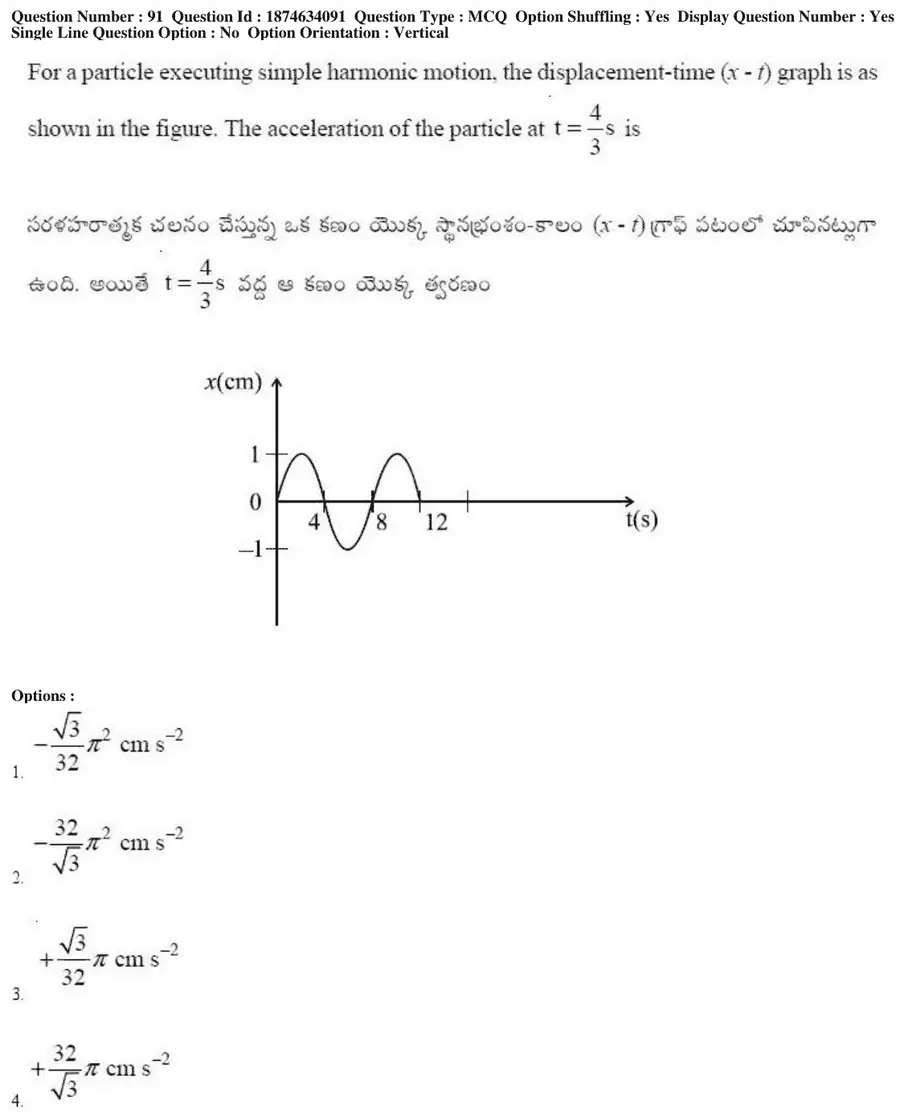
For a particle executing simple harmonic motion, the displacement-time ($x$ - $t$) graph is as shown in the figure. The acceleration of the particle at $t = \frac{4}{3}$ s is (see the figure above)
When a body is in SHM, then match the following. List - I A) Velocity is maximum B) KE is $\left(\frac{3}{4}\right)^{\mathrm{th}}$ of total energy C) PE is $\left(\frac{3}{4}\right)^{\mathrm{th}}$ of total energy D) Acceleration is maximum List - II I) At extreme position II) At mean position III) At half of the amplitude IV) At $\frac{\sqrt{3}}{2}$ times the amplitude The correct answer is
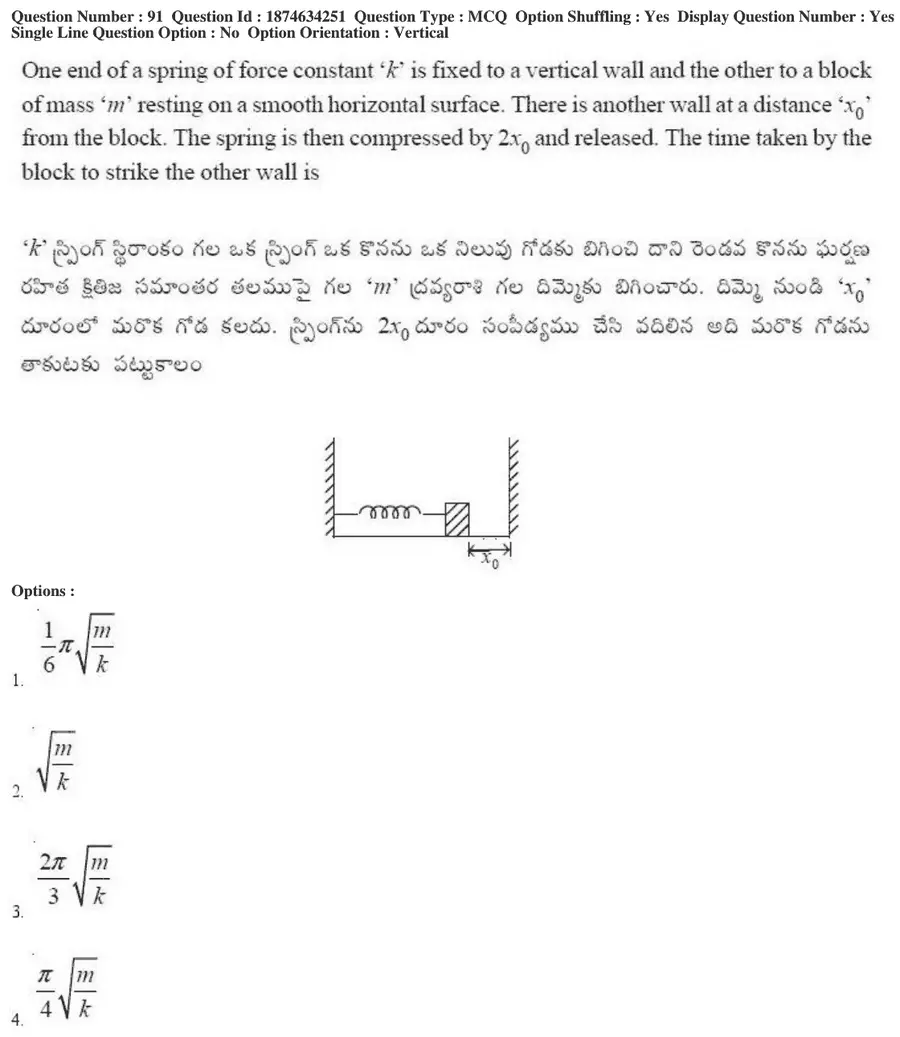
One end of a spring of force constant '$k$' is fixed to a vertical wall and the other to a block of mass '$m$' resting on a smooth horizontal surface. There is another wall at a distance '$x_0$' from the block. The spring is then compressed by $2x_0$ and released. The time taken by the block to strike the other wall is (see the figure above)
A simple pendulum is placed inside a lift, which is moving with a uniform acceleration. If the time periods of the pendulum while the lift is moving upwards and downwards are in the ratio 1:2, then the acceleration of the lift is (Acceleration due to gravity = $10\ \mathrm{ms^{-2}}$)
The position of a particle executing simple harmonic motion is given by $x(t) = 2\cos\left(\frac{\pi}{15}t - \frac{\pi}{2}\right)$ where $x$ is in cm and $t$ is in seconds. The time period of the kinetic energy of the particle in seconds is
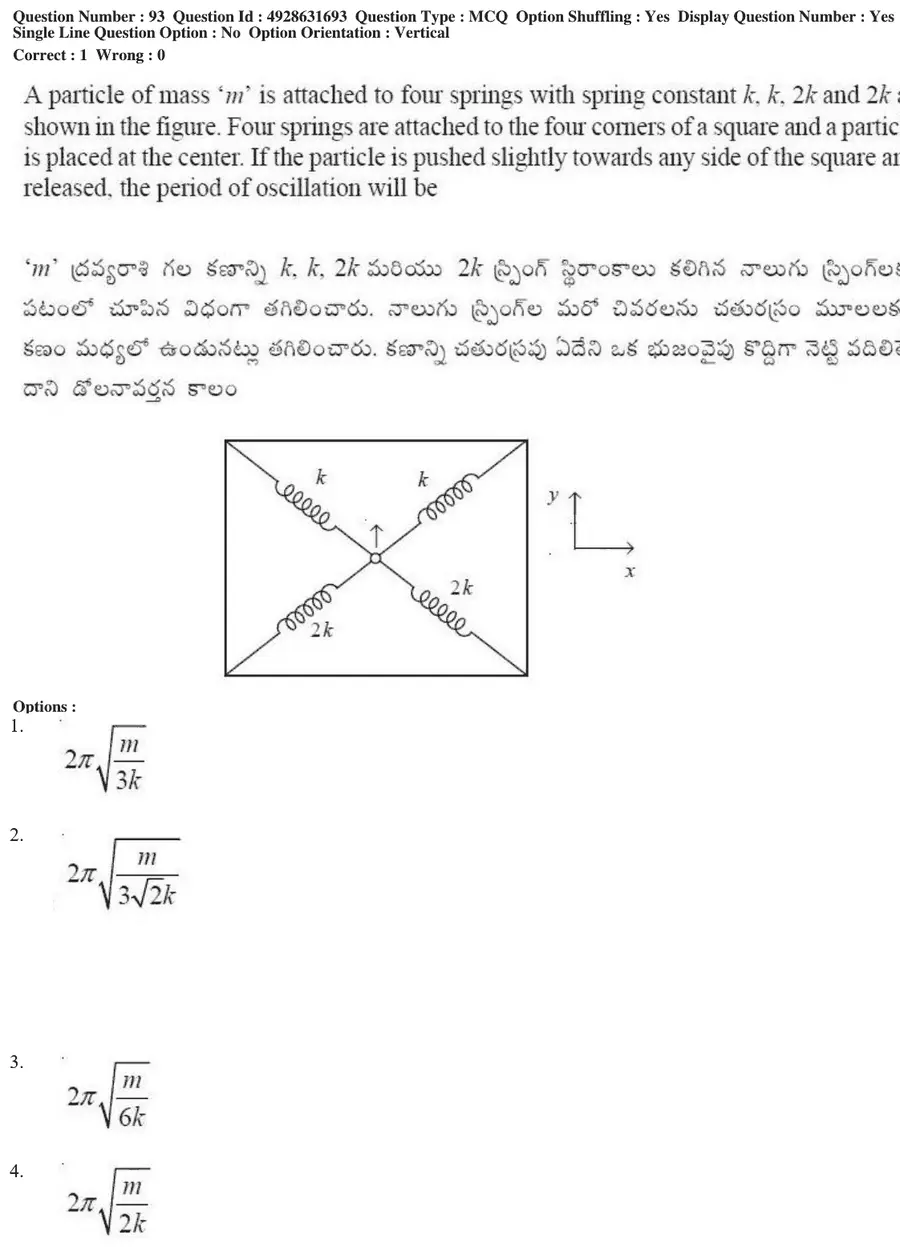
A particle of mass '$m$' is attached to four springs with spring constant $k$, $k$, $2k$ and $2k$ as shown in the figure. Four springs are attached to the four corners of a square and a particle is placed at the center. If the particle is pushed slightly towards any side of the square and released, the period of oscillation will be (see the figure above)
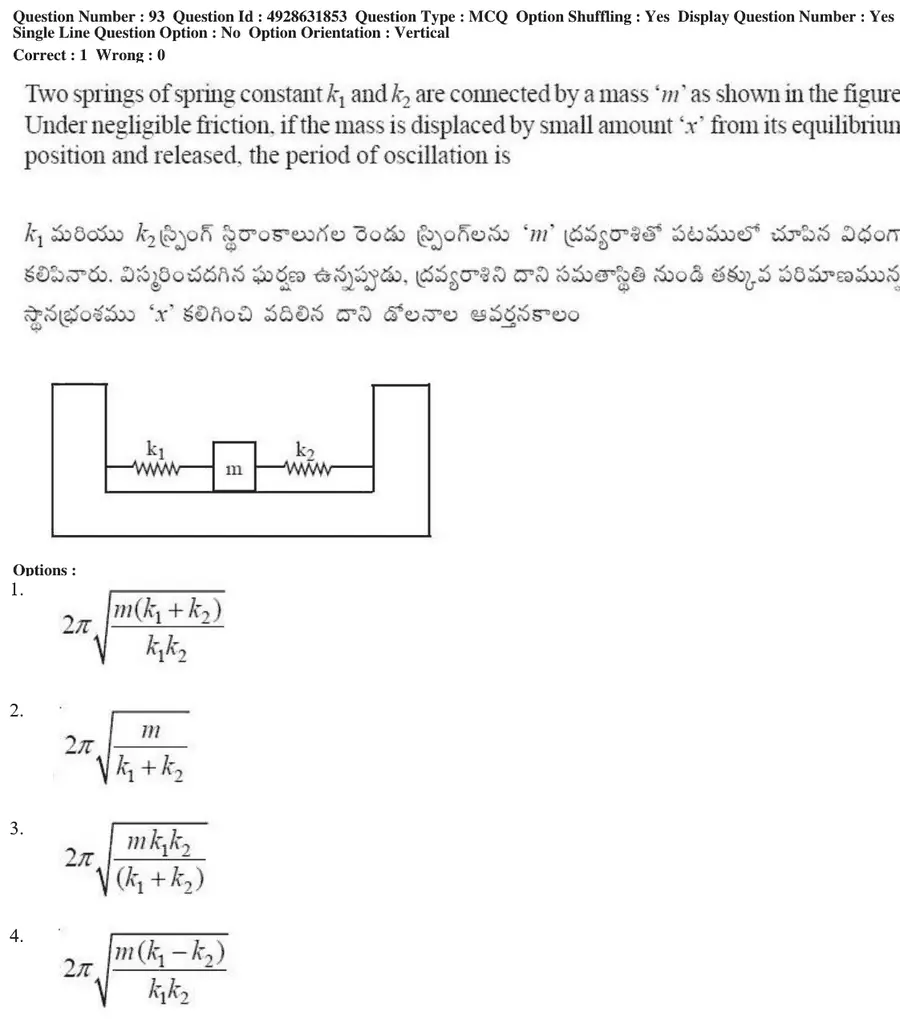
Two springs of spring constant $k_1$ and $k_2$ are connected by a mass 'm' as shown in the figure. Under negligible friction, if the mass is displaced by small amount 'x' from its equilibrium position and released, the period of oscillation is (see the figure above)
At $t = 0$, a particle executing SHM with a time period 3 s is in phase with another particle executing SHM. The time period of the second particle is T (less than 3 s). If they are again in the same phase for the third time after 45 s, then the value of T is ________
A particle starts executing simple harmonic motion from one extreme position. If a, b and c are the displacements of the particle from the mean position at the ends of three successive seconds, the frequency of simple harmonic motion is ______
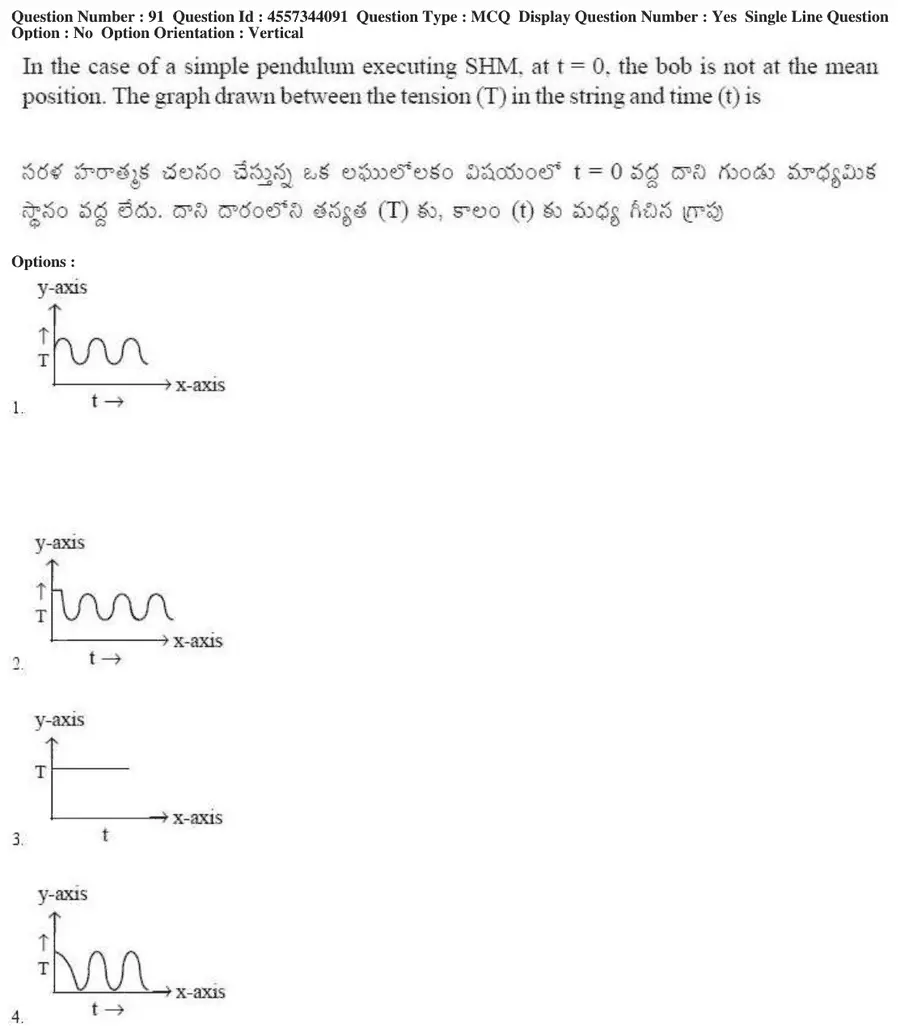
In the case of a simple pendulum executing SHM, at $t = 0$, the bob is not at the mean position. The graph drawn between the tension (T) in the string and time (t) is (see the figure above)
The question as printed in the paper.
A
see figure T-t graph (y-axis T, x-axis t): short wavy curve, about three humps, small amplitude, starting low
B
see figure T-t graph: wavy curve, about four humps, larger amplitude
C
see figure T-t graph: horizontal straight line (constant T)
D
see figure T-t graph: wavy curve starting from a high point, about three humps, shrinking toward the t-axis
The displacement of a particle of mass 2 g executing SHM is given by $y = 5\sin\left(4t + \dfrac{\pi}{3}\right)$. Here y is in metres and t is in seconds. The kinetic energy of the particle when $t = \dfrac{T}{4}$ is
One end of a long metallic wire of length L, area of cross-section A and Young's modulus Y is tied to the ceiling. The other end is tied to a massless spring of force constant K and a mass 'm' is hung from the free end of the spring. If 'm' is slightly pulled down and released, then its time period of oscillation is
The potential energy of a simple harmonic oscillator of mass $2\ \mathrm{kg}$ at its mean position is $5\ \mathrm{J}$. If its total energy is $9\ \mathrm{J}$ and amplitude is $1\ \mathrm{cm}$, then its time period is
A simple pendulum with a bob of mass $40\ \mathrm{g}$ and charge $+2\ \mu\mathrm{C}$ makes 20 oscillations in 44 seconds. A vertical electric field of magnitude $4.2\times10^{4}\ \mathrm{NC^{-1}}$ pointing downward is applied. The time taken by the pendulum to make 15 oscillations in the electric field is (Acceleration due to gravity $= 10\ \mathrm{ms^{-2}}$)
A particle is executing S.H.M. The time taken for $\left(\frac{3}{8}\right)^{\mathrm{th}}$ of oscillation from extreme position is 'X'. Then the time taken for the particle to complete $\left(\frac{5}{8}\right)^{\mathrm{th}}$ of oscillation from mean position is
A simple pendulum of length 1 m is freely suspended from the ceiling of an elevator. The time period of small oscillations as the elevator moves up with an acceleration of $2\,\mathrm{m/s^2}$ is (use $g = 10\,\mathrm{m/s^2}$)
Time period of a simple pendulum of length 'L' is $T_1$. Time period of a uniform rod of same length 'L' suspended from one end and oscillating in a vertical plane is $T_2$. Amplitude of oscillation is small in both cases. Then, $\dfrac{T_1}{T_2}$ is
A particle starting from mean position executes simple harmonic motion with a period 8 s. The minimum time in which its potential energy becomes half of the total energy is ______.
Two particles executing SHM along a straight line have same amplitude 'A' and time period 'T'. At $t=0$, one particle is at a displacement $+A$ and another is at a displacement $-\dfrac{A}{2}$ and they are approaching towards each other. They cross each other after a time.
The displacement of a particle in an oscillatory motion at a time 't' is given by $x=8\sin\frac{\pi t}{4}$ cm, then its displacement in the time interval $t=0$ s to $t=2$ s is
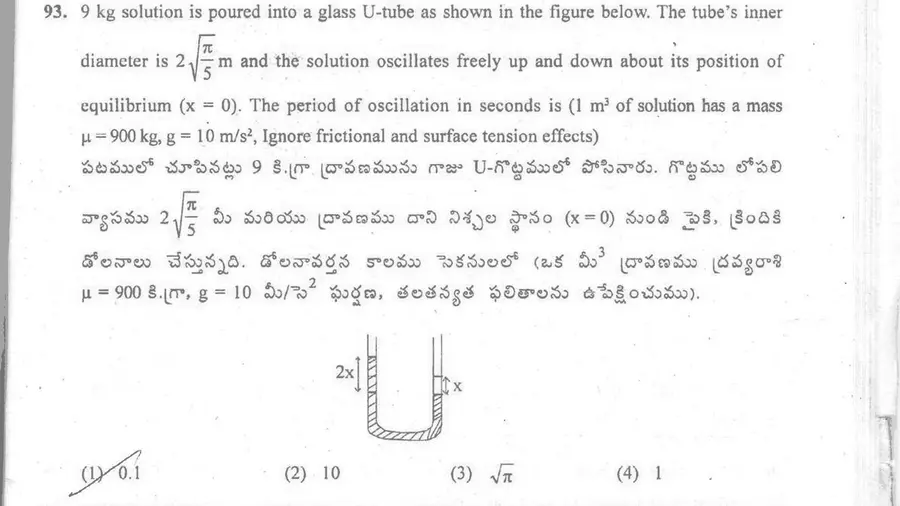
9 kg solution is poured into a glass U-tube as shown in the figure below. The tube's inner diameter is $2\sqrt{\frac{\pi}{5}}$ m and the solution oscillates freely up and down about its position of equilibrium (x = 0). The period of oscillation in seconds is (1 $\mathrm{m^3}$ of solution has a mass $\mu = 900$ kg, $g = 10\ \mathrm{m/s^2}$, Ignore frictional and surface tension effects) (see the figure above)
A particle is executing simple harmonic motion with an amplitude of 2 m. The difference in the magnitudes of its maximum acceleration and maximum velocity is 4. The time period of its oscillation and its velocity when it is 1 m away from the mean position are respectively.
The ratio between kinetic and potential energies of a body executing simple harmonic motion, when it is at a distance of $\frac{1}{N}$ of its amplitude from the mean position is
Two particles A and B of masses 'm' and '2m' are suspended from two massless springs of force constants $K_1$ and $K_2$. During their oscillation, if their maximum velocities are equal, then ratio of amplitudes of A and B is
The time period of a particle in simple harmonic motion is 8s. At t = 0, it is at the mean position. The ratio of the distances travelled by it in the first and second seconds is
A simple harmonic oscillator consists of a particle of mass 'm' and an ideal spring with spring constant 'k'. The particle oscillates with a time period 'T'. The spring is cut into two equal parts. If one part oscillates with the same particle, the time period will be :
The displacements of two particles of same mass executing SHM are represented by the equations $x_1 = 4\sin\left(10t + \frac{\pi}{6}\right)$ and $x_2 = 5\cos(\omega t)$. The value of '$\omega$' for which the energy of both the particles remain same is :
Oscillations and simple harmonic motion form a cornerstone of Class 11 mechanics in both Andhra Pradesh and Telangana engineering entrance papers. In the papers we hold for AP and TS EAPCET between 2022 and 2026, the chapter contributed 122 questions across 77 papers. That yields an average of 1.6 questions per paper, representing 4.0% of all physics questions in that recent window. Looking at the complete archive from 2010 to 2026, Oscillations (SHM) generated 208 questions across 149 papers, maintaining an average of 1.4 questions per paper and a 3.5% subject share. Across the earlier testing period from 2010 to 2021, our archive contains 86 questions across 72 papers (3.0% share). In the last three exam years from 2024 to 2026, the chapter delivered 74 questions across 46 papers, registering a 4.0% share. When comparing the last three years to early papers, the chapter's share of the subject is up, whereas compared to the recent five-year window it is about the same.
State-wise breakdowns show that AP sittings test harmonic motion substantially more often than TS sittings. Between 2022 and 2026, AP EAPCET papers in our set contributed 92 questions across 48 papers, averaging 1.9 questions per paper and accounting for 4.8% of the AP physics section. Over the identical timeframe, TS EAPCET provided 30 questions across 29 papers in our set, averaging 1.0 question per paper and taking a 2.6% share. Oscillations (SHM) has appeared every year since 2022 and featured in every paper across both states in the recent five-year window. It ranks 10th of 28 physics chapters by question share between 2022 and 2026. The busiest single sitting in our collection was 2021, which yielded 27 questions across 17 papers.
Most-asked topics
Questions distribute across four distinct syllabus areas:
Oscillating Systems: A leading block of 39 questions appeared between 2022 and 2026, out of 69 questions across all years in our archive. It tests the period of simple pendulums, spring-mass systems in series and parallel, torsional pendulums, liquid columns in U-tubes, and floating cylinders.
SHM Basics: This section supplied 38 questions in the recent five-year window and 70 questions overall. Key concepts include displacement, velocity, acceleration equations, phase relationships, reference circles, and superposition of collinear oscillations.
Energy in SHM: Recent papers contributed 28 questions, out of 46 questions in the full dataset. Questions focus on kinetic energy, potential energy, total mechanical energy, and their variation with position and time.
Damped & Forced Oscillations: Examiners asked 17 questions recently, bringing the all-time archive count to 23 questions. Topics cover amplitude decay envelopes, damping constants, logarithmic decrement, and resonance conditions.
What the questions look like
Kinematics of simple harmonic motion provides steady questions testing phase leads and coordinate projections. Students are frequently given velocities at two specified displacements and asked to solve for angular frequency ω, amplitude A, or maximum acceleration. Another common format gives the projection of uniform circular motion on a diameter and asks for the analytical displacement equation x(t) with appropriate initial phase.
In oscillating systems, questions frequently modify the physical setup. Typical problems ask what happens to the period of a simple pendulum when suspended in an accelerating lift, immersed in a non-viscous liquid, or placed in a vehicle negotiating a curve. Spring combinations also recur, requiring effective spring constant calculations when springs are cut into unequal lengths or arranged in parallel versus series configurations.
Start by mastering the fundamental differential equation d²x/dt² + ω² x = zero. Write the displacement as x = A sin(ω t + φ). The velocity is v = ω √(A² - x²), and acceleration is a = - ω² x. Remember the critical phase relationships: velocity leads displacement by π/two radians, while acceleration leads displacement by π radians (or opposes it in sign).
Next, work through energy relations. Potential energy is U = (1/2) k x² = (1/2) m ω² x², and kinetic energy is K = (1/2) m v² = (1/2) m ω² (A² - x²). Total mechanical energy E = (1/2) m ω² A² is strictly constant in undamped motion. Note that while displacement oscillates with frequency f, kinetic and potential energies oscillate with twice that frequency, 2f.
Finally, review standard physical systems. For a simple pendulum of length L, the period is T = 2 π √(L / g_eff). For a spring of constant k cut into parts with length ratio m : n, the stiffer piece has constant k(m + n) / m. For a torsional pendulum with rotational inertia I and torsional stiffness C, the period is T = 2 π √(I / C).
Frequently asked questions
Does Oscillations (SHM) appear in every paper?
Yes. In the papers we hold from 2022 to 2026, Oscillations (SHM) appeared in every single paper across both AP and TS EAPCET, with AP shifts averaging nearly two questions each.
At what displacement are kinetic and potential energies equal in SHM?
Kinetic energy equals potential energy when (1/2) k (A² - x²) = (1/2) k x², which gives displacement x = A / √2.
What is the frequency of energy oscillation in SHM?
If a particle executes simple harmonic motion with frequency f, both its kinetic energy and potential energy complete two cycles per oscillation period, oscillating at frequency 2f.
Where can I find worked solutions for EAPCET Oscillations (SHM) questions?
Step-by-step solutions for each one are in the EdLoop EAPCET app.