EdLoop PYQs · free, no ads · questions and answers here, step-by-step solutions in the EdLoop app
PYQs · free, no adsOpen on the web (app.edloop.in)Get EdLoop – free on Google Play
PhysicsCommunication Systems

Communication Systems: AP & TS EAPCET PYQs 2012–2026

Every Communication Systems question from past AP EAPCET and TS EAPCET papers, with options and answers. Newest first.

133questions
133papers covered
2.5%of Physics questions, 2022–2026
2012–2026years

Guide at a glance

Communication Systems provides a concise applied chapter that concludes the Class 12 physics curriculum. In the papers we hold for AP and TS EAPCET between 2022 and 2026, this chapter accounted for 76 questions across 77 papers.

Most asked sub-topics

Modulation67
Communication Basics66

Practise these in EdLoop

Attempt every Communication Systems question timed, see the step-by-step solution and track what you get wrong. Free.

Start practice

All questions

133 questions
1AP EAPCET 2026 · 18 May · Shift 1MCQOpen question page ↗

If the wavelength of signal to be transmitted by an antenna is increased by 2 times, then the effective power radiated by antenna

  • A

    Becomes $\frac{1}{4}$ times of the initial value

  • B

    Increases by 4 times of initial value

  • C

    Remains same

  • D

    Becomes $\frac{1}{2}$ times of the initial value

2AP EAPCET 2026 · 18 May · Shift 2MCQOpen question page ↗

A TV transmitting antenna is 81 m tall. Service area covered, if the receiving antenna is at the ground level, will be about

  • A

    $2500\ \mathrm{km^2}$

  • B

    $3250\ \mathrm{km^2}$

  • C

    $4250\ \mathrm{km^2}$

  • D

    $1525\ \mathrm{km^2}$

3AP EAPCET 2026 · 15 May · Shift 1MCQOpen question page ↗

An audio signal $10 \sin 2\pi(1500)t$ volt amplitude modulates a carrier $40 \sin 2\pi(10^5)t$ volts. The modulation factor and percentage modulation are

  • A

    0.25, 25%

  • B

    0.40, 40%

  • C

    0.10, 10%

  • D

    0.50, 50%

4AP EAPCET 2026 · 15 May · Shift 2MCQOpen question page ↗

Video signals for the transmission of pictures require a frequency bandwidth of

  • A

    20.6 Hz

  • B

    20.5 kHz

  • C

    6.8 GHz

  • D

    4.2 MHz

5AP EAPCET 2026 · 14 May · Shift 1MCQOpen question page ↗

A carrier wave of frequency $2\ MHz$ and peak voltage $15\ V$ is used to modulate a message signal of frequency $20\ kHz$ and peak voltage $8\ V$. The frequencies of side bands produced are

  • A

    $2000\ kHz, 20\ kHz$

  • B

    $2020\ kHz, 1980\ kHz$

  • C

    $2040\ kHz, 1960\ kHz$

  • D

    $2020\ kHz, 2000\ kHz$

6AP EAPCET 2026 · 14 May · Shift 2MCQOpen question page ↗

In amplitude modulation, if the modulation index is 0.8 and the peak voltage of the message signal is 10 V, then the amplitudes of the upper and lower side bands of the modulated wave are respectively

  • A

    22.5V, 2.5V

  • B

    12.5V, 10V

  • C

    5V,5V

  • D

    10V, 5V

7AP EAPCET 2026 · 13 May · Shift 1MCQOpen question page ↗

If $f_m$ is a modulating frequency and $f_c$ is carrier wave frequency, then Bandwidth in Amplitude Modulated wave is

  • A

    $2f_c$

  • B

    $f_c + f_m$

  • C

    $2f_m$

  • D

    $\frac{(f_c + f_m)}{2}$

8AP EAPCET 2026 · 13 May · Shift 2MCQOpen question page ↗

A carrier wave of peak voltage $12\ V$ is used to transit a message signal. If the modulation index is $75\ \%$, then the peak voltage of the modulating signal is

  • A

    $16\ V$

  • B

    $9\ V$

  • C

    $6\ V$

  • D

    $8\ V$

10AP EAPCET 2026 · 12 May · Shift 2MCQOpen question page ↗

For an amplitude modulated wave, maximum and minimum amplitudes are found to be 12 V and 4 V. modulation index is

  • A

    50 %

  • B

    25 %

  • C

    75 %

  • D

    60 %

12TS EAPCET 2026 · 11 May · Shift 2MCQOpen question page ↗

If the peak voltage of message signal is 60% less than the peak voltage of the carrier wave, then the modulation index is

  • A

    0.3

  • B

    0.4

  • C

    0.6

  • D

    0.2

13TS EAPCET 2026 · 10 May · Shift 1MCQOpen question page ↗

In amplitude modulation, if the amplitude of the message signal is increased by 20% and the amplitude of the carrier wave is decreased by 20%, then the percentage increase in the modulation index is

  • A

    75

  • B

    40

  • C

    25

  • D

    50

14TS EAPCET 2026 · 10 May · Shift 2MCQOpen question page ↗

For an amplitude modulated wave, if the maximum amplitude is 400% more than its minimum amplitude, then the modulation index is

  • A

    $\frac{3}{4}$

  • B

    $\frac{1}{4}$

  • C

    $\frac{2}{3}$

  • D

    $\frac{1}{2}$

15TS EAPCET 2026 · 9 May · Shift 1MCQOpen question page ↗

The layer of the atmosphere that efficiently reflects high frequency waves particularly at night is

  • A

    Mesosphere

  • B

    Troposphere

  • C

    Stratosphere

  • D

    Thermosphere

16TS EAPCET 2026 · 9 May · Shift 2MCQOpen question page ↗

If the length of a linear antenna is increased by 60% and the wavelength of the signal is decreased by 20%, then the percentage increase in the effective power radiated by the antenna is

  • A

    50

  • B

    250

  • C

    300

  • D

    150

17AP EAPCET 2025 · 27 May · Shift 1MCQOpen question page ↗

In amplutide modulation, if a message signal of 5 kHz is modulated by a carrier wave of frequency 900 kHz, then the frequencies of the side bands are

  • A

    905 kHz, 895 kHz

  • B

    900 kHz, 800 kHz

  • C

    800 kHz, 700 kHz

  • D

    1000 kHz, 900 kHz

18AP EAPCET 2025 · 26 May · Shift 1MCQOpen question page ↗

The heights of tansmitting and receiving antennas are respectively $\frac{1}{20000}$ and $\frac{1}{80000}$ times the radius of the earth. The maximum distance between these two antennas for satisfactory communication in line of sight mode is
(Radius of the earth $= 6.4\times10^{6}$ m)

  • A

    48 km

  • B

    96 km

  • C

    320 km

  • D

    192 km

19AP EAPCET 2025 · 26 May · Shift 2MCQOpen question page ↗

The layer of the atmosphere that reflects low frequency (LF) electromagnetic waves during day time only is

  • A

    D

  • B

    E

  • C

    $\mathrm{F_1}$

  • D

    $\mathrm{F_2}$

20AP EAPCET 2025 · 24 May · Shift 1MCQOpen question page ↗

If the ratio of the maximum and minimum amplitudes of an amplitude modulated wave is $7 : 3$, then the modulation index is

  • A

    0.6

  • B

    0.7

  • C

    0.4

  • D

    0.3

21AP EAPCET 2025 · 23 May · Shift 1MCQOpen question page ↗

If the maximum and minimum amplitudes of a modulated wave are 25 V and 5 V respectively, then the modulation index is

  • A

    $\frac{1}{5}$

  • B

    $\frac{1}{3}$

  • C

    $\frac{3}{2}$

  • D

    $\frac{2}{3}$

22AP EAPCET 2025 · 23 May · Shift 2MCQOpen question page ↗

Ionosphere acts as a reflector for the frequency range of

  • A

    3 – 30 kHz

  • B

    3 – 30 MHz

  • C

    3 – 30 Hz

  • D

    3 – 30 GHz

23AP EAPCET 2025 · 22 May · Shift 1MCQOpen question page ↗

If in an amplitude modulated wave, the maximum amplitude is 14 V and the modulation index is 0.4, then the amplitude of the carrier wave is

  • A

    4 V

  • B

    8 V

  • C

    12 V

  • D

    10 V

25AP EAPCET 2025 · 21 May · Shift 1MCQOpen question page ↗

If the sum of heights of transmitting and receiving antennas in line of sight of communication is ‘h’, then the height of receiving antenna, to have the range maximum is

  • A

    $\frac{h}{2}$

  • B

    $\frac{h}{4}$

  • C

    $2h$

  • D

    $\frac{2h}{3}$

26AP EAPCET 2025 · 21 May · Shift 2MCQOpen question page ↗

In amplitude modulation of waves, the maximum amplitude is 30 mV and minimum amplitude is 5 mV, then the modulation index is

  • A

    $\frac{4}{7}$

  • B

    $\frac{3}{7}$

  • C

    $\frac{5}{7}$

  • D

    $\frac{2}{7}$

27TS EAPCET 2025 · 4 May · Shift 1MCQOpen question page ↗

The radio horizon of a transmitting antenna of height 39.2 m is

(Radius of the earth = 6400 km)

  • A

    44.8 km

  • B

    19.6 km

  • C

    22.4 km

  • D

    78.4 km

28TS EAPCET 2025 · 4 May · Shift 2MCQOpen question page ↗

If the frequencies of the carrier wave and message signal are 1 MHz and 28 kHz respectively, then the frequencies of the side bands are

  • A

    1014 kHz, 986 kHz

  • B

    1028 kHz, 972 kHz

  • C

    29 kHz, 27 kHz

  • D

    514 kHz, 486 kHz

29TS EAPCET 2025 · 3 May · Shift 1MCQOpen question page ↗

When the receiving antenna is on the ground, the range of a transmitting antenna of height 980 m is
(Radius of the earth = 6400 km)

  • A

    56 km

  • B

    112 km

  • C

    72.4 km

  • D

    224 km

30TS EAPCET 2025 · 3 May · Shift 2MCQOpen question page ↗

The layer of the atmosphere which efficiently reflects high frequency waves particularly at night is

  • A

    Troposphere

  • B

    Stratosphere

  • C

    Mesosphere

  • D

    Thermosphere

31TS EAPCET 2025 · 2 May · Shift 1MCQOpen question page ↗

For commercial telephonic communication, the frequency range adequate for speech signals is

  • A

    20 Hz - 20 kHz

  • B

    300 Hz - 3100 Hz

  • C

    200 MHz - 600 MHz

  • D

    300 kHz - 8000 kHz

32TS EAPCET 2025 · 2 May · Shift 2MCQOpen question page ↗

Coaxial cable, a widely used wire medium offers an approximate frequency bandwidth of

  • A

    750 GHz

  • B

    750 Hz

  • C

    750 MHz

  • D

    750 kHz

34AP EAPCET 2024 · 22 May · Shift 1MCQOpen question page ↗

The maximum distance between the transmitting and receiving antennas for satisfactory communication in line of sight mode is 57.6 km. If the height of the receiving antenna is 80 m, the height of the transmitting antenna is (Radius of earth = $6.4 \times 10^{6}$ m)

  • A

    28.8 m

  • B

    51.2 m

  • C

    25.6 m

  • D

    14.4 m

35AP EAPCET 2024 · 22 May · Shift 2MCQOpen question page ↗

Which one of the following is not classified as pulse modulation

  • A

    Pulse duration modulation

  • B

    Pulse Amplitude Modulation

  • C

    Pulse band Modulation

  • D

    Pulse position Modulation

36AP EAPCET 2024 · 21 May · Shift 1MCQOpen question page ↗

An information signal of frequency $10\ \mathrm{kHz}$ is modulated with a carrier wave of frequency $3.61\ \mathrm{MHz}$. The upper side and lower side frequencies are:

  • A

    $3650\ \mathrm{kHz}$ and $3590\ \mathrm{kHz}$

  • B

    $3620\ \mathrm{kHz}$ and $3600\ \mathrm{kHz}$

  • C

    $3610\ \mathrm{kHz}$ and $3580\ \mathrm{kHz}$

  • D

    $3600\ \mathrm{kHz}$ and $3620\ \mathrm{kHz}$

37AP EAPCET 2024 · 20 May · Shift 1MCQOpen question page ↗

A carrier is simultaneously modulated by two sine waves with modulation indices of 0.3 and 0.4; then the total modulation index is

  • A

    1

  • B

    0.12

  • C

    0.5

  • D

    0.7

38AP EAPCET 2024 · 20 May · Shift 2MCQOpen question page ↗

In amplitude modulation, the amplitude of the carrier wave is $10\ \mathrm{V}$ and the amplitude of one of the side bands is $2\ \mathrm{V}$. Then the modulation index is

  • A

    0.4

  • B

    0.6

  • C

    0.7

  • D

    0.5

39AP EAPCET 2024 · 19 May · Shift 2MCQOpen question page ↗

A message signal of 3 kHz is used to modulate a carrier signal frequency 1 MHz, using amplitude modulation. The upper side band frequency and band width respectively are

  • A

    1.003 MHz and 6KHz

  • B

    0.997 MHz and 6KHz

  • C

    1.003 MHz and 3KHz

  • D

    1.003 MHz and 2MHz

40AP EAPCET 2024 · 18 May · Shift 1MCQOpen question page ↗

If the maximum and minimum voltages of an A.M wave are $V_{\max}$ and $V_{\min}$ respectively. Then the modulation factor ‘m’ is

  • A

    $(V_{\max} + V_{\min})/(V_{\max} \cdot V_{\min})$

  • B

    $(V_{\max} - V_{\min})/(V_{\max} + V_{\min})$

  • C

    $2 V_{\max} V_{\min}/(V_{\max} + V_{\min})$

  • D

    $(V_{\max} + V_{\min})/(V_{\max} - V_{\min})$

41TS EAPCET 2024 · 11 May · Shift 1MCQOpen question page ↗

The maximum distance between the transmitting and receiving antennas is D. If the heights of both transmitting and receiving antennas are doubled, then the maximum distance between the two antennas is

  • A

    $2D$

  • B

    $D\sqrt{2}$

  • C

    $4D$

  • D

    $\frac{D}{\sqrt{2}}$

42TS EAPCET 2024 · 10 May · Shift 1MCQOpen question page ↗

The process of the loss of strength of a signal while propagating through a medium is

  • A

    damping

  • B

    attenuation

  • C

    amplification

  • D

    modulation

43TS EAPCET 2024 · 10 May · Shift 2MCQOpen question page ↗

For an amplitude modulated wave, the maximum and minimum amplitudes are found to be 10 V and 2 V respectively. Then the modulation index is

  • A

    $\frac{1}{3}$

  • B

    $\frac{3}{4}$

  • C

    $\frac{1}{5}$

  • D

    $\frac{2}{3}$

44TS EAPCET 2024 · 9 May · Shift 1MCQOpen question page ↗

The heights of the transmitting and receiving antennas are 33.8 m and 64.8 m respectively. The maximum distance between the antennas for satisfactory communication in line of sight mode is
(Radius of the earth = 6400 km)

  • A

    20.8 km

  • B

    28.8 km

  • C

    49.6 km

  • D

    57.6 km

45TS EAPCET 2024 · 9 May · Shift 2MCQOpen question page ↗

A message signal of peak voltage 12 V is used to amplitude modulate a carrier signal of frequency 1.2 MHz. The amplitude of the side bands is

  • A

    12 V

  • B

    3 V

  • C

    6 V

  • D

    8 V

46AP EAPCET 2023 · 19 May · Shift 1MCQOpen question page ↗

A message signal of frequency 14 kHz is used to modulate a carrier of frequency 900 kHz, then the frequencies of side bands are

  • A

    907 kHz, 893 kHz

  • B

    920 kHz, 880 kHz

  • C

    914 kHz, 886 kHz

  • D

    900 kHz, 914 kHz

47AP EAPCET 2023 · 18 May · Shift 1MCQOpen question page ↗

Digital signal

  • A

    is represented by a sine wave

  • B

    utilizes binary code system

  • C

    is represented by a cosine wave

  • D

    utilizes a hexadecimal code

48AP EAPCET 2023 · 18 May · Shift 2MCQOpen question page ↗

For an amplitude modulated wave, the maximum and minimum amplitudes are 12 V and 3 V respectively. Then the modulation index is

  • A

    0.4

  • B

    0.9

  • C

    0.6

  • D

    0.3

49AP EAPCET 2023 · 17 May · Shift 1MCQOpen question page ↗

The radio horizon of the transmission of an antenna placed on $20^{\mathrm{th}}$ floor in a shopping mall, where the height of each floor is 2 m is

(Radius of earth is $6.4\times10^{6}\,\mathrm{m}$)

  • A

    $22.6\ \mathrm{km}$

  • B

    $45\ \mathrm{km}$

  • C

    $36\ \mathrm{km}$

  • D

    $67.5\ \mathrm{km}$

51AP EAPCET 2023 · 16 May · Shift 1MCQOpen question page ↗

An amplitude modulated wave is represented by $10\left[1+0.6\sin(40\times10^{3}t)\right]\sin(4\times10^{6}t)$ volt where t is in seconds. Then the ratio of the upper to the lower side band frequencies is

  • A

    $101 : 99$

  • B

    $100 : 99$

  • C

    $100 : 1$

  • D

    $10 : 1$

52AP EAPCET 2023 · 16 May · Shift 2MCQOpen question page ↗

The process of retrieval of information from the carrier wave

  • A

    Amplification

  • B

    Attenuation

  • C

    Modulation

  • D

    Demodulation

53AP EAPCET 2023 · 15 May · Shift 1MCQOpen question page ↗

A carrier wave of peak voltage $15\ \mathrm{V}$ is used to transmit a message signal. If the modulation index is $60\%$, then the peak voltage of the modulating signal is

  • A

    $3\ \mathrm{V}$

  • B

    $6\ \mathrm{V}$

  • C

    $9\ \mathrm{V}$

  • D

    $12\ \mathrm{V}$

54AP EAPCET 2023 · 15 May · Shift 2MCQOpen question page ↗

Band width of an optical fiber is

  • A

    more than 100 GHz

  • B

    less than 1 MHz

  • C

    less than 1 GHz

  • D

    less than 100 kHz

55TS EAPCET 2023 · 14 May · Shift 1MCQOpen question page ↗

An amplitude modulated wave is represented by $c_m(t)=10[1+0.6\sin(1250t)]\sin(10^8 t)$. Then the modulation index is

  • A

    10

  • B

    1250

  • C

    $10^8$

  • D

    0.6

56TS EAPCET 2023 · 14 May · Shift 2MCQOpen question page ↗

Consider the following statements regarding digital signals.

i) provide a continuous set of values

ii) represent values as discrete steps

iii) can utilise binary system

iv) are in the form of rectangular waves

Then the true statements are

  • A

    (i), (ii)

  • B

    (ii), (iii)

  • C

    (ii), (iii), (iv)

  • D

    (i), (ii), (iii), (iv)

57TS EAPCET 2023 · 13 May · Shift 1MCQOpen question page ↗

The loss of strength of a signal while propagating through a medium is known as

  • A

    Modulation

  • B

    Demodulation

  • C

    Attenuation

  • D

    Noise

58TS EAPCET 2023 · 13 May · Shift 2MCQOpen question page ↗

A telephonic communication service is working at a carrier frequency of 20 GHz. Only 20% of it is utilized for transmission. If each channel requires a bandwidth of 5 kHz, then the number of telephonic channels that can be transmitted simultaneously are

  • A

    $6 \times 10^5$

  • B

    $2 \times 10^5$

  • C

    $8 \times 10^5$

  • D

    $4 \times 10^5$

59TS EAPCET 2023 · 12 May · Shift 1MCQOpen question page ↗

A message signal of frequency 10 kHz is used to modulate a carrier wave of frequency 6 MHz, then the side band frequencies are

  • A

    6090 kHz, 610 kHz

  • B

    5990 kHz, 6010 kHz

  • C

    6000 Hz, 1000 Hz

  • D

    6000 kHz, 6100 kHz

60TS EAPCET 2023 · 12 May · Shift 2MCQOpen question page ↗

The need for modulation is

  • A

    to increase the intensity of audio signal

  • B

    to decrease the intensity of audio signal

  • C

    to transmit audio signal to large distances

  • D

    to increase the frequency of audio signal

61TS EAPCET 2022 · 20 Jul · Shift 1MCQOpen question page ↗

A carrier wave of peak voltage 10 V is used to transmit a message signal. What should be the peak voltage of the modulating signal in order to have a modulation index of 80%

  • A

    8 V

  • B

    8.8 V

  • C

    5 V

  • D

    12.5 V

62TS EAPCET 2022 · 20 Jul · Shift 2MCQOpen question page ↗

For an amplitude modulated wave, the modulation index is found to be 0.5. If the maximum amplitude is found to be 10.0 V, then the minimum amplitude is

  • A

    5.0 V

  • B

    3.33 V

  • C

    2.5 V

  • D

    6.66 V

63TS EAPCET 2022 · 19 Jul · Shift 1MCQOpen question page ↗

The range of frequency bands used for standard AM broadcast is

  • A

    $540-1600$ KHz

  • B

    $88-108$ MHz

  • C

    $800-900$ MHz

  • D

    $3.7-4.2$ GHz

64TS EAPCET 2022 · 19 Jul · Shift 2MCQOpen question page ↗

Which of the following statements is NOT true?

  • A

    Power radiated from a linear antenna is directly proportional to square of antenna length

  • B

    Power radiated decreases with increasing frequency

  • C

    Antenna should have size comparable to the wavelength of the signal

  • D

    Effective power radiated by a long wavelength baseband signal is small

65TS EAPCET 2022 · 18 Jul · Shift 1MCQOpen question page ↗

A TV transmission antenna is 40 m tall. How much service area it can cover if the receiving antenna is at the ground level?
(radius of the Earth = 6400 km)

  • A

    $640\pi\times10^{6}\ \mathrm{m^{2}}$

  • B

    $512\pi\times10^{6}\ \mathrm{m^{2}}$

  • C

    $480\pi\times10^{6}\ \mathrm{m^{2}}$

  • D

    $440\pi\times10^{6}\ \mathrm{m^{2}}$

66TS EAPCET 2022 · 18 Jul · Shift 2MCQOpen question page ↗

A message signal of frequency 15 kHz is used to modulate a carrier of frequency $\upsilon_{c}$. If the side bands produced are 1515 kHz and 1485 kHz, then $\upsilon_{c}$ is

  • A

    2.0 MHz

  • B

    1.5 MHz

  • C

    2.5 MHz

  • D

    3.0 MHz

67AP EAPCET 2022 · 8 Jul · Shift 1MCQOpen question page ↗

The amplitude of the side bands of the modulated signal if the carrier signal and message signal amplitudes are 25 V and 5 V respectively is

  • A

    $0.5\ \mathrm{V}$

  • B

    $2.5\ \mathrm{V}$

  • C

    $0.2\ \mathrm{V}$

  • D

    $5\ \mathrm{V}$

68AP EAPCET 2022 · 8 Jul · Shift 2MCQOpen question page ↗

A carrier wave of peak voltage 60 V is used to transmit a message signal. Then the peak voltage of the modulating signal in order to have a modulation index of 90% is

  • A

    $30\ \mathrm{V}$

  • B

    $54\ \mathrm{V}$

  • C

    $45\ \mathrm{V}$

  • D

    $60\ \mathrm{V}$

69AP EAPCET 2022 · 7 Jul · Shift 1MCQOpen question page ↗

The frequency band for uplink satellite communication in the following is

  • A

    $5.9 - 6.4$ GHz

  • B

    $54 - 72$ MHz

  • C

    $88 - 108$ MHz

  • D

    $540 - 1600$ KHz

71AP EAPCET 2022 · 6 Jul · Shift 1MCQOpen question page ↗

A message signal of frequency 8 kHz and peak voltage 12 V is used to modulate a carrier of frequency 1.2 MHz and peak voltage 20 V. The modulation index is

  • A

    0.2

  • B

    0.3

  • C

    0.4

  • D

    0.6

72AP EAPCET 2022 · 6 Jul · Shift 2MCQOpen question page ↗

The maximum amplitude of an AM wave is found to be 20 V while its minimum amplitude is 4 V. The modulation index is

  • A

    $0.33$

  • B

    $0.67$

  • C

    $0.44$

  • D

    $0.63$

73AP EAPCET 2022 · 5 Jul · Shift 1MCQOpen question page ↗

Frequencies in the UHF range normally propagate by means of

  • A

    Space waves

  • B

    Surface waves

  • C

    Ground waves

  • D

    Sky waves

74AP EAPCET 2022 · 5 Jul · Shift 2MCQOpen question page ↗

The frequency suitable beyond the horizon communication using sky wave is

  • A

    $10\ \mathrm{KHz}$

  • B

    $10\ \mathrm{MHz}$

  • C

    $1\ \mathrm{GHz}$

  • D

    $1000\ \mathrm{GHz}$

76AP EAPCET 2022 · 4 Jul · Shift 2MCQOpen question page ↗

A carrier wave is used to transmit a message signal. If the peak voltage of modulating signal and carrier signal are increased by 1% and 3% respectively, the modulation index is changed by

  • A

    $-2\ \%$

  • B

    $4\ \%$

  • C

    $2\ \%$

  • D

    $-4\ \%$

77AP EAMCET 2021 · 5 Oct · Shift 1MCQOpen question page ↗

A microwave telephone like operating at the central frequency of $10\times10^{9}\ Hz$ has been established if 2 % of this is available for microwave communication channel. How many telephone channels can be simultaneously granted if each telephone is allotted a bandwidth of 8 $kHz$?

  • A

    $1.5\times10^{3}$

  • B

    $3.5\times10^{2}$

  • C

    $2.5\times10^{4}$

  • D

    $4.5\times10^{6}$

78AP EAMCET 2021 · 25 Aug · Shift 2MCQOpen question page ↗

In an amplitude modulation with modulation index 0.5, the ratio of the amplitude of the carrier wave to that of the side band in the modulated wave is ________

  • A

    $4 : 1$

  • B

    $1 : 4$

  • C

    $1 : 2$

  • D

    $2 : 1$

79AP EAMCET 2021 · 24 Aug · Shift 1MCQOpen question page ↗

In a communication system operating at wavelength $800\ \mathrm{nm}$, only one percent of source frequency is available as signal bandwidth. The number of channels accommodated for transmitting TV signals of bandwidth $6\ \mathrm{MHz}$ is ______

  • A

    $\frac{1}{25} \times 10^{7}$

  • B

    $\frac{1}{21} \times 10^{7}$

  • C

    $\frac{1}{16} \times 10^{7}$

  • D

    $\frac{1}{12} \times 10^{7}$

80AP EAMCET 2021 · 23 Aug · Shift 1MCQOpen question page ↗

If the highest modulating frequency of the wave is $5\ kHz$, the number of stations that can be accommodated in a $150\ kHz$ bandwidth is ______

  • A

    20

  • B

    15

  • C

    10

  • D

    5

81AP EAMCET 2021 · 19 Aug · Shift 2MCQOpen question page ↗

In an amplitude modulated signal the maximum amplitude is $15\ \mathrm{V}$ and minimum amplitude is $5\ \mathrm{V}$. The amplitude of modulating wave will be

  • A

    $5\ \mathrm{V}$

  • B

    $10\ \mathrm{V}$

  • C

    $20\ \mathrm{V}$

  • D

    $30\ \mathrm{V}$

82TS EAMCET 2021 · 6 Aug · Shift 1MCQOpen question page ↗

For an amplitude modulated wave, the maximum amplitude is found to be 10 V while the minimum amplitude is found to be 4 V. The modulation index is

  • A

    $\frac{2}{5}$

  • B

    $\frac{2}{3}$

  • C

    $\frac{3}{7}$

  • D

    $\frac{4}{7}$

83TS EAMCET 2021 · 6 Aug · Shift 2MCQOpen question page ↗

A TV transmission tower of height h covers a range of distance 'd'. By how much will be the range change if the height is increased to $\dfrac{3}{2}h$

  • A

    $\sqrt{\dfrac{3}{2}}\,d$

  • B

    $\left(\sqrt{\dfrac{3}{2}}-1\right)d$

  • C

    $\left(\sqrt{\dfrac{3}{2}}+1\right)d$

  • D

    $d$

84TS EAMCET 2021 · 5 Aug · Shift 1MCQOpen question page ↗

The height of transmitting antenna if TV programs have to cover the population in area of radius 64 km is [Use Radius of earth = $6.4\times10^{6}$ m]

  • A

    160 m

  • B

    200 m

  • C

    240 m

  • D

    320 m

85TS EAMCET 2021 · 5 Aug · Shift 2MCQOpen question page ↗

A carrier wave of peak voltage 15 V is used to transmit a message signal. What should be the peak voltage of the modulating signal in order to have a modulation index of 80 %?

  • A

    8 V

  • B

    10 V

  • C

    11 V

  • D

    12 V

86TS EAMCET 2021 · 4 Aug · Shift 1MCQOpen question page ↗

A message signal of frequency $f_m$ is used to modulate a carrier of frequency $f_c$. If the side bands are $f_1$ and $f_2$ then the ratio $\frac{f_c}{f_m}$ is

  • A

    $\left|\frac{f_1+f_2}{f_2-f_1}\right|$

  • B

    $\frac{(f_1+f_2)^2}{f_1 f_2}$

  • C

    $\left|\frac{f_1-f_2}{f_2+f_1}\right|$

  • D

    $\frac{f_1 f_2}{(f_1+f_2)^2}$

87TS EAMCET 2021 · 4 Aug · Shift 2MCQOpen question page ↗

A signal of 20 kHz is being carried on a carrier wave of 3 MHz. What are the side band frequencies?

  • A

    $3050\ \mathrm{kHz}$ & $2950\ \mathrm{kHz}$

  • B

    $3020\ \mathrm{kHz}$ & $2970\ \mathrm{kHz}$

  • C

    $3050\ \mathrm{kHz}$ & $2980\ \mathrm{kHz}$

  • D

    $3020\ \mathrm{kHz}$ & $2980\ \mathrm{kHz}$

88AP EAMCET 2020 · 7 Oct · Shift 1MCQOpen question page ↗

A T.V. tower has a height of $100\ m$. The average population density around the tower is $1000\ km^{-2}$ and radius of the earth is $6.37 \times 10^{6} m$. The population covered is ______

  • A

    $4 \times 10^{6}$

  • B

    $6 \times 10^{4}$

  • C

    $16 \times 10^{4}$

  • D

    $8 \times 10^{6}$

89AP EAMCET 2020 · 23 Sep · Shift 1MCQOpen question page ↗

For television broadcasting, the frequency employed is normally in range ______

  • A

    $30-300\ \mathrm{MHz}$

  • B

    $30-300\ \mathrm{GHz}$

  • C

    $30-300\ \mathrm{kHz}$

  • D

    $30-300\ \mathrm{Hz}$

90AP EAMCET 2020 · 22 Sep · Shift 2MCQOpen question page ↗

A speech signal of 3 $\mathrm{kHz}$ is used to modulate a carrier signal of frequency 1 $\mathrm{MHz}$, using amplitude modulation. The frequencies of the side bands will be ______

  • A

    1.003 $\mathrm{MHz}$ & 0.997 $\mathrm{MHz}$

  • B

    3001 $\mathrm{kHz}$ & 2997 $\mathrm{kHz}$

  • C

    1003 $\mathrm{kHz}$ & 1000 $\mathrm{kHz}$

  • D

    1.0 $\mathrm{MHz}$ & 0.997 $\mathrm{MHz}$

91AP EAMCET 2020 · 18 Sep · Shift 1MCQOpen question page ↗

An AM wave has $1800\,\mathrm{W}$ of total power content, for 100% modulation the carrier should have power content equal to

  • A

    $1000\,\mathrm{W}$

  • B

    $1200\,\mathrm{W}$

  • C

    $1500\,\mathrm{W}$

  • D

    $1600\,\mathrm{W}$

92TS EAMCET 2020 · 14 Sep · Shift 1MCQOpen question page ↗

The function of a detector is to demodulate the modulated carrier wave and the steps for this process are

  • A

    demodulation and filtering

  • B

    demodulation and rectification

  • C

    rectification and filtering

  • D

    regeneration and filtering

93TS EAMCET 2020 · 14 Sep · Shift 2MCQOpen question page ↗

A message signal of frequency $\dfrac{50}{\pi}$ kHz and peak voltage of 5 V is used to modulate a carrier of frequency 1 MHz and peak voltage 20 V. The modulation index is

  • A

    $\dfrac{\pi}{10}$

  • B

    0.4

  • C

    0.5

  • D

    0.25

94TS EAMCET 2020 · 11 Sep · Shift 1MCQOpen question page ↗

A message signal is super-imposed with a carrier signal. The resulting modulating signal $C_m(t)$ is given by $C_m(t) = A_1\sin(\omega_1 t) + A_2\sin(\omega_2 t) - A_2\sin(\omega_3 t)$ where $\omega_2 < \omega_1 < \omega_3$. The modulation index and the angular frequency of the message signal respectively are

  • A

    $\dfrac{A_2}{A_1},\ \dfrac{\omega_3-\omega_2}{2}$

  • B

    $\dfrac{2A_2}{A_1},\ \omega_3-\omega_2$

  • C

    $\dfrac{A_1}{2A_2},\ \dfrac{\omega_3-\omega_2}{2}$

  • D

    $\dfrac{2A_2}{A_1},\ \dfrac{\omega_3-\omega_2}{2}$

95TS EAMCET 2020 · 11 Sep · Shift 2MCQOpen question page ↗

The electromagnetic waves of frequency 6 GHz are used in

  • A

    FM broadcast

  • B

    TV communication

  • C

    Satellite communication

  • D

    Cellular mobile radio

96TS EAMCET 2020 · 10 Sep · Shift 1MCQOpen question page ↗

A message signal of frequency 10 KHz and peak voltage of 15 volts is used to modulate a carrier frequency of 1 MHz and peak voltage of 30 volts. Determine the modulation index.

  • A
    1. 5
  • B
    1. 6
  • C
    1. 7
  • D
    1. 8
97TS EAMCET 2020 · 10 Sep · Shift 2MCQOpen question page ↗

Assertion (A): Television signals are received through sky- wave propagation
Reason(R): The iono sphere reflects electromagnetic waves of frequencies in the range (3 - 30) M Hz
The correct option among the following is

  • A

    (A) is true, (R) is true and (R) is the correct explanation for (A)

  • B

    (A) is true, (R) is true but (R) is not the correct explanation for (A)

  • C

    (A) is true but (R) is false

  • D

    (A) is false but (R) is true

98TS EAMCET 2020 · 9 Sep · Shift 1MCQOpen question page ↗

A carrier signal of frequency $\nu_1$ and peak voltage of $V_1$ is modulated by a message signal of frequency $\nu_2$ and peak voltage of $V_2$. Let $m$ be the modulation index and $\nu_+, \nu_-$ be side bands produced. The correct statement is

  • A

    $m = \frac{V_1}{V_2}$

  • B

    $\nu_1 = \frac{\nu_+ + \nu_-}{2}$

  • C

    $\nu_2 = \frac{\nu_+ + \nu_-}{2}$

  • D

    $m > \frac{V_2}{V_1}$

99TS EAMCET 2020 · 9 Sep · Shift 2MCQOpen question page ↗

The modulation index used in amplitude modulation of a message signal of peak voltage 10 volts is 0.5. By how much the peak voltage of the carrier signal be changed so as to obtain the modulation index of 0.8, keeping the peak voltage of the message signal same as before.

  • A

    increase by 7.5 V

  • B

    reduce by 7.5 V

  • C

    increase by 12.5 V

  • D

    reduce by 12.5 V

100TS EAMCET 2019 · 6 May · Shift 1MCQOpen question page ↗

A message signal is used to modulate a carrier signal of frequency 5 MHz and peak voltage of 40 V. In the process, two sidebands are produced seperated by 40 KHz. If the modulation index is 0.75, then the peak voltage and frequency of the message signal respectively are:

  • A

    60 V ; 10 KHz

  • B

    60 V ; 20 KHz

  • C

    30 V ; 10 KHz

  • D

    30 V ; 20 KHz

101TS EAMCET 2019 · 4 May · Shift 1MCQOpen question page ↗

A transmitting antenna has a height 20 m. What will be the height of receiving antenna, if the maximum distance between them for satisfactory communication in line-of-sight (LOS) mode is 40 km? (The earth radius is 6400 km)

  • A

    $25\ \mathrm{m}$

  • B

    $30\ \mathrm{m}$

  • C

    $60\ \mathrm{m}$

  • D

    $45\ \mathrm{m}$

102TS EAMCET 2019 · 4 May · Shift 2MCQOpen question page ↗

Carrier waves are used for communicating signals over a long distance, because

  • A

    Carrier waves can be generated very easily

  • B

    Low frequencies can not be easily modulated by the carrier waves

  • C

    Low frequencies can be transmitted over long distances

  • D

    Carrier waves that are generated at higher frequencies can be transmitted over long distances

103TS EAMCET 2019 · 3 May · Shift 1MCQOpen question page ↗

A message signal is used to modulate a carrier frequency. If the peak voltages of message signal and carrier signal are increased by 0.1% and 0.3% respectively, then the percentage change in modulation index is

  • A

    0.4

  • B

    0.0

  • C

    $-0.4$

  • D

    $-0.2$

104TS EAMCET 2019 · 3 May · Shift 2MCQOpen question page ↗

The transmitting antenna placed at the top of a tower has a height of $45\ \mathrm{m}$ from the ground. The distance between receiving and transmitting antennas is $40\ \mathrm{km}$ and the radius of earth is $6400\ \mathrm{km}$. The minimum height (in m) at which the receiving antenna is to be placed for satisfactory communication in LOS mode, is

  • A

    $5$

  • B

    $15$

  • C

    $20$

  • D

    $25$

105AP EAMCET 2019 · 23 Apr · Shift 1MCQOpen question page ↗

If $E_c$ and $E_m$ are peak values of carrier and modulating signals respectively then for 100% modulation

  • A

    $E_c = \frac{E_m}{2}$

  • B

    $\frac{E_c^2}{2} = E_m^2$

  • C

    $E_c = E_m$

  • D

    $E_c = 2E_m$

106AP EAMCET 2019 · 22 Apr · Shift 1MCQOpen question page ↗

A TV tower has a height 160 m. Its coverage range is nearly (Earth's radius = 6400 km)

  • A

    45255 m

  • B

    55265 m

  • C

    452.55 km

  • D

    552.65 m

107AP EAMCET 2019 · 22 Apr · Shift 2MCQOpen question page ↗

Coaxial cable, a widely used wire medium for transmission of signals offers a bandwidth of approximately

  • A

    $600\ \mathrm{kHz}$

  • B

    $750\ \mathrm{MHz}$

  • C

    $850\ \mathrm{GHz}$

  • D

    $500\ \mathrm{Hz}$

108AP EAMCET 2019 · 21 Apr · Shift 1MCQOpen question page ↗

A transmitting antenna of height 20 m and the receiving antenna of height 'h' are separated by a distance of 40 km for satisfactory communication in line of sight mode. Then the value of 'h' is (Given Radius of earth is 6400 km)

  • A

    40 m

  • B

    45 m

  • C

    30 m

  • D

    25 m

109AP EAMCET 2019 · 21 Apr · Shift 2MCQOpen question page ↗

The frequency suitable for beyond-the-horizon communication using sky waves is

  • A

    $10^{12}\ \mathrm{Hz}$

  • B

    $10^{9}\ \mathrm{Hz}$

  • C

    $10^{7}\ \mathrm{Hz}$

  • D

    $10^{4}\ \mathrm{Hz}$

110AP EAMCET 2019 · 20 Apr · Shift 1MCQOpen question page ↗

A signal of frequency 10 kHz and peak voltage 10 V is used to amplitude modulate a carrier of frequency 1 MHz and peak voltage 20 V. The side band frequencies in kHz are

  • A

    1010, 990

  • B

    910, 1090

  • C

    10, 11

  • D

    1.01, 0.99

111AP EAMCET 2019 · 20 Apr · Shift 2MCQOpen question page ↗

A TV tower has a height of 5 m in a region of population density $\frac{1000}{\pi}$ per square kilometer. Number of people that can receive the transmission is nearly (in thousands)

  • A

    $128$

  • B

    $64$

  • C

    $256$

  • D

    $32$

112TS EAMCET 2018 · 7 May · Shift 1MCQOpen question page ↗

For a television network, $5\times10^5$ channels are granted. If the central frequency of the microwave link is 25 GHz and the alloted bandwidth for each channel is 2 kHz, how much percentage of the link is used for the network?

  • A

    4%

  • B

    10%

  • C

    25%

  • D

    5%

113TS EAMCET 2018 · 5 May · Shift 1MCQOpen question page ↗

A transmitting and receiving antenna have height of 'd' meters each. The maximum distance between them for satisfactory communication in Line-of-Sight mode (LOS) is $2d$ kilometers. If the radius of earth is 6400 km, then the value of $d$ is

  • A

    3.2 m

  • B

    6.4 m

  • C

    12.8 m

  • D

    16.0 m

114TS EAMCET 2018 · 5 May · Shift 2MCQOpen question page ↗

The height of a transmission antenna is $49\ \mathrm{m}$ and that of the receiving antenna is $64\ \mathrm{m}$. What should be the maximum distance between them for line of sight transmission?

  • A

    $50.1\ \mathrm{km}$

  • B

    $53.6\ \mathrm{km}$

  • C

    $43.6\ \mathrm{km}$

  • D

    $65.2\ \mathrm{km}$

115TS EAMCET 2018 · 4 May · Shift 1MCQOpen question page ↗

A carrier wave of peak voltage 20 V is used to transmit a message signal. For getting modulation index of 60%, the peak voltage of the modulating signal is

  • A

    6 V

  • B

    8 V

  • C

    12 V

  • D

    33.3 V

116TS EAMCET 2018 · 4 May · Shift 2MCQOpen question page ↗

A person tries to broadcast with the same antenna both the signals at $10^{7}$ Hz and $10^{6}$ Hz. If the receiver at some distance has to receive an equal strength for both the frequencies, the broadcaster has to approximately increase the signal strength at $10^{6}$ Hz to $10^{7}$ Hz by

  • A

    $\dfrac{1}{10}$ times

  • B

    10 times

  • C

    100 times

  • D

    $\dfrac{1}{100}$ times

117AP EAMCET 2018 · 24 Apr · Shift 1MCQOpen question page ↗

A modulated signal is given by $C_m(t) = A_c \sin\omega_c t + \mu A_c \sin\omega_m t\,\sin\omega_c t$ where $\mu$ is modulation index. To keep the signal without distortion, the value of $\mu$ should be

  • A

    $> 1$

  • B

    $\geq 1$

  • C

    $= 1$

  • D

    $\leq 1$

118AP EAMCET 2018 · 24 Apr · Shift 2MCQOpen question page ↗

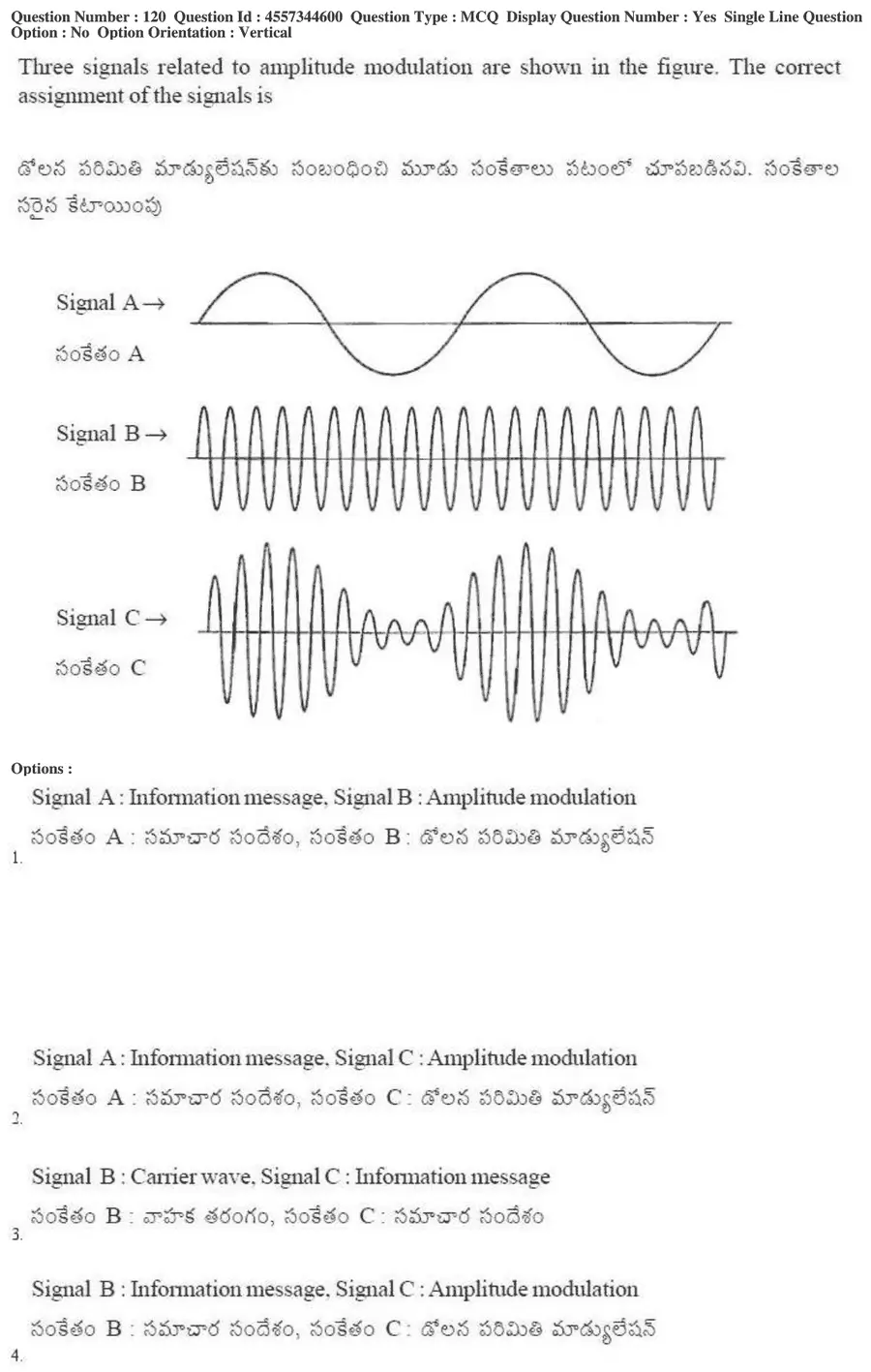
Three signals related to amplitude modulation are shown in the figure. The correct assignment of the signals is
(see the figure above)

The question and its figure as printed in AP EAPCET 2018 24th April Shift 2.
The question as printed in the paper.
  • A

    Signal A : Information message, Signal B : Amplitude modulation

  • B

    Signal A : Information message, Signal C : Amplitude modulation

  • C

    Signal B : Carrier wave, Signal C : Information message

  • D

    Signal B : Information message, Signal C : Amplitude modulation

119AP EAMCET 2018 · 23 Apr · Shift 1MCQOpen question page ↗

A TV transmitter has a range of 50 km. The height of the TV transmitter is ______
(Radius of the earth $\mathrm{R_e} = 6.4\times10^{6}$ m)

  • A

    195.3 m

  • B

    186.5 m

  • C

    206 m

  • D

    175 m

120AP EAMCET 2018 · 23 Apr · Shift 2MCQOpen question page ↗

If the height of the transmitting tower is increased by 30%, the area covered by it increases by

  • A

    10%

  • B

    21%

  • C

    30%

  • D

    60%

121AP EAMCET 2018 · 22 Apr · Shift 1MCQOpen question page ↗

If a message signal of frequency $10\ \mathrm{kHz}$ and peak voltage $12\ \mathrm{V}$ is used to modulate a carrier wave of frequency $1\ \mathrm{MHz}$, the modulation index is $0.6$. To make the modulation index $0.75$, the carrier peak voltage should be

  • A

    decreased by 25%

  • B

    increased by 25%

  • C

    decreased by 20%

  • D

    increased by 20%

122AP EAMCET 2018 · 22 Apr · Shift 2MCQOpen question page ↗

The maximum distance between the transmitting and receiving TV towers is 65 km. If the ratio of the heights of the TV transmitting tower to receiving tower is 36 : 49, the heights of the transmitting and receiving towers respectively are (Radius of earth 6400 km)

  • A

    $51.2\ \mathrm{m},\ 80\ \mathrm{m}$

  • B

    $70.3\ \mathrm{m},\ 95.7\ \mathrm{m}$

  • C

    $30\ \mathrm{m},\ 65\ \mathrm{m}$

  • D

    $25\ \mathrm{m},\ 75\ \mathrm{m}$

123TS EAMCET 2017 · 12 May · OfflineMCQOpen question page ↗

An amplitude modulated signal consists of a message signal of frequency 1 KHz and peak voltage of 5V, modulating a carrier frequency of 1 MHz and peak voltage of 15V. The correct description of this signal is

  • A

    $5\left[1+3\sin(2\pi 10^{6}t)\right]\sin(2\pi 10^{3}t)$

  • B

    $15\left[1+\dfrac{1}{3}\sin(2\pi 10^{3}t)\right]\sin(2\pi 10^{6}t)$

  • C

    $\left[5+15\sin(2\pi 10^{3}t)\right]\sin(2\pi 10^{6}t)$

  • D

    $\left[15+5\sin(2\pi 10^{6}t)\right]\sin(2\pi 10^{3}t)$

124AP EAMCET 2017 · 26 Apr · Shift 1MCQOpen question page ↗

The process of recovering the modulating signal from the modulated carrier wave is called

  • A

    Amplification

  • B

    Rectification

  • C

    Noise

  • D

    Detection

125AP EAMCET 2017 · 26 Apr · Shift 2MCQOpen question page ↗

Match the following :
List - I (Signal)
i) Speech Signal
ii) Music Signal
iii) Video Signal
iv) T.V. Signal
List - II (Bandwidth)
a) $4.2\ \mathrm{MHz}$
b) $6\ \mathrm{MHz}$
c) $20\ \mathrm{KHz}$
d) $2.8\ \mathrm{KHz}$
The correct answer is

  • A

    i-c, ii-d, iii-b, iv-a

  • B

    i-a, ii-d, iii-b, iv-c

  • C

    i-d, ii-c, iii-a, iv-b

  • D

    i-b, ii-a, iii-d, iv-c

126AP EAMCET 2017 · 25 Apr · Shift 1MCQOpen question page ↗

If the length of an antenna is 150 cm, the transmission frequency is ______ MHz (Speed of light in vacuum = $3\times10^{8}\ \mathrm{ms^{-1}}$)

  • A

    25

  • B

    150

  • C

    50

  • D

    100

127AP EAMCET 2017 · 25 Apr · Shift 2MCQOpen question page ↗

TV transmission antenna at a particular station has a height of 100 m. By how much the height of the antenna is to be increased to double its coverage range?

  • A

    $41.4\ \mathrm{m}$

  • B

    $121.4\ \mathrm{m}$

  • C

    $70.7\ \mathrm{m}$

  • D

    $100\ \mathrm{m}$

128AP EAMCET 2017 · 24 Apr · Shift 1MCQOpen question page ↗

A TV tower has a height of 150 m. If the population density around the TV tower is $10^3\ \mathrm{km^{-2}}$ then the population covered by the tower is (Radius of the earth, $R=6.4\times10^6\ \mathrm{m}$)

  • A

    $60.288$ lakh

  • B

    $40.192$ lakh

  • C

    $106.486$ lakh

  • D

    $26.428$ lakh

129AP EAMCET 2017 · 24 Apr · Shift 2MCQOpen question page ↗

If two linear antennas having lengths in the ratio 2 : 3 are emitting radiation of wavelength in the ratio 8 : 9, then the ratio of effective powers radiated by them are in the ratio

  • A

    32 : 27

  • B

    27 : 32

  • C

    16 : 27

  • D

    9 : 16

130TS EAMCET 2016 · 15 May · OfflineMCQOpen question page ↗

A message signal of 12 kHz and peak voltage 20 V is used to modulate a carrier wave of frequency 12 MHz and peak voltage 30 V. Then the modulation index is

  • A

    0.32

  • B

    6.7

  • C

    0.67

  • D

    67

131AP EAMCET 2016 · 29 Apr · OfflineMCQOpen question page ↗

If a transmitting antenna of height 105m is placed on a hill, then its coverage area is

  • A

    $4224\ \mathrm{km^2}$

  • B

    $3264\ \mathrm{km^2}$

  • C

    $6400\ \mathrm{km^2}$

  • D

    $4864\ \mathrm{km^2}$

132AP EAMCET 2014 · 22 May · OfflineMCQOpen question page ↗

A T.V transmitting Antenna is 128 m tall. If the receiving Antenna is at the ground level, the maximum distance between them for satisfactory communication in L.O.S. mode is, (Radius of the earth = $6.4 \times 10^6$ m)

  • A

    $64 \times \sqrt{10}$ km

  • B

    $\frac{128}{\sqrt{10}}$ km

  • C

    $128 \times \sqrt{10}$ km

  • D

    $\frac{64}{\sqrt{10}}$ km

133AP EAMCET 2012 · 12 May · OfflineMCQOpen question page ↗

Match column A (layers in the ionosphere for skywave propagation) with column B (their height range) :
Column A
I) D-layer
II) E-layer
III) $F_1$-layer
IV) $F_2$-layer
Column B
a) 250-400 km
b) 170-190 km
c) 95-120 km
d) 65-75 km
The correct answer is

  • A

    I-a, II-b, III-c, IV-d

  • B

    I-d, II-c, III-a, IV-b

  • C

    I-d, II-c, III-b, IV-a

  • D

    I-c, II-d, III-c, IV-b

How to prepare Communication Systems for EAPCET

How often it comes up

Communication Systems provides a concise applied chapter that concludes the Class 12 physics curriculum. In the papers we hold for AP and TS EAPCET between 2022 and 2026, this chapter accounted for 76 questions across 77 papers. That gives an average frequency of 1.0 question per paper, making up 2.5% of all physics questions in that recent window. Taking the full historical record from 2010 to 2026 into account, Communication Systems contributed 133 questions across 149 papers, maintaining an average of 0.9 questions per paper and a 2.2% subject share. For early years between 2010 and 2021, our records capture 57 questions across 72 papers (2.0% share). Over the last three exam years from 2024 to 2026, it provided 45 questions across 46 papers, registering a 2.4% share. Compared with the early period, the subject share in the last three years is about the same, and when set against the recent five-year window it is likewise about the same.

State-level distributions indicate equal representation across both regional entrance boards. AP EAPCET papers between 2022 and 2026 contributed 47 questions across 48 papers in our set, with 47 papers containing questions (1.0 per paper, 2.4% share). TS EAPCET contributed 29 questions across 29 papers in our set, with all 29 papers featuring questions (1.0 per paper, 2.5% share). Communication Systems has appeared every year since 2022, though across all 77 recent papers in our collection, one AP sitting omitted it, meaning it did not feature in all 77 sittings. By question volume between 2022 and 2026, it occupies the 24th rank among the 28 physics chapters. Sittings in 2022, 2025, and 2026 tied as the busiest years in our archive, each supplying 16 questions across 16 papers.

Most-asked topics

Questions distribute across two balanced syllabus areas:

  • Modulation: This leading division brought 40 questions between 2022 and 2026, contributing to 67 questions across all years in our archive. It tests amplitude modulation index μ = A_m / A_c, maximum and minimum envelope voltages, sideband frequencies (f_c ± f_m), transmission bandwidth two f_m, and power relationships in AM waves.
  • Communication Basics: This part brought 36 questions across the recent five years and 66 questions across our entire archive. Key concepts cover transmitter and receiver blocks, ground wave, sky wave, and space wave propagation, critical frequency, skip distance, line-of-sight transmission distance d = √(two R h_t) + √(two R h_r), and antenna length criteria.

What the questions look like

Amplitude modulation calculations represent the core problem type in this chapter. A classic question provides the maximum envelope amplitude A_max and minimum envelope amplitude A_min of an AM signal on an oscilloscope screen and asks for the modulation index μ = (A_max - A_min) / (A_max + A_min). Another frequent variant tests undistorted transmission criteria, requiring students to identify that the modulation index must remain less than or equal to unity (μ ≤ 1) to prevent envelope distortion and overmodulation.

Wave propagation and antenna problems form the other recurring group. Students are frequently asked for the maximum line-of-sight range between a transmitting antenna of height h_t and a receiving antenna of height h_r on the spherical Earth. Another standard problem evaluates how the radiated power of a linear antenna scales with wavelength, relying on the inverse square law where radiated power P ∝ (l / λ)². Sky wave propagation questions test ionospheric reflection mechanisms, such as identifying the critical frequency or determining which ionospheric layer reflects night-time high-frequency waves.

Questions to try first

How to practise it

Start by mastering amplitude modulation formulas. An amplitude modulated wave consists of a carrier component and two sidebands: upper sideband at frequency f_c + f_m and lower sideband at f_c - f_m. The required transmission bandwidth is two f_m. Total power in an AM wave is P_total = P_carrier [1 + μ² / two]. When modulation index reaches its maximum distortionless value μ = 1, sideband power accounts for exactly one third of total transmitted power, with the remaining two thirds carried by the unmodulated carrier.

Next, study electromagnetic wave propagation modes. Ground waves attenuate rapidly through surface absorption, limiting their utility to frequencies below two megahertz. Sky waves reflect from the ionosphere via total internal refraction for frequencies below the critical frequency f_c = nine √(N_max). Space waves operate above forty megahertz in line-of-sight configurations: the radio horizon distance for a tower of height h is d = √(two R h), where R is the radius of the Earth, and maximum line-of-sight range between towers is d_max = √(two R h_t) + √(two R h_r).

Finally, review antenna specifications. For effective radiation of an electromagnetic signal, the physical antenna dimension should be comparable to wavelength, with the minimum length of a linear dipole antenna given by λ / four.

Frequently asked questions

Is Communication Systems included in the EAPCET syllabus?

Yes. Although removed from national entrance syllabi, Communication Systems remains an active, regularly tested chapter in both AP and TS EAPCET exams.

What is the maximum distortionless modulation index for AM?

For undistorted amplitude modulation without envelope clipping, the modulation index μ must satisfy the condition μ ≤ 1, or between zero and one hundred percent.

What is the bandwidth of an amplitude modulated wave?

The transmission channel bandwidth required for an AM wave equals twice the highest modulating signal frequency, Bandwidth = two f_m.

Where can I find worked solutions for EAPCET Communication Systems questions?

Step-by-step solutions for each one are in the EdLoop EAPCET app.

Get EdLoop – freeOpen on the web