
EdLoop PYQs · free, no ads · questions and answers here, step-by-step solutions in the EdLoop app
PYQs · free, no adsOpen on the web (app.edloop.in)Get EdLoop – free on Google Play
PhysicsWave Optics

AP EAPCET 2026 (13th May 2026 Shift 2) Physics: Wave Optics

Multiple choice, one correct option AP EAPCET paper Wave Optics

AP EAPCET 2026 · 13 May · Shift 2PhysicsWave OpticsMCQ

The correct relation between fringe width ($\beta$) and distance between the slits ($d$) is
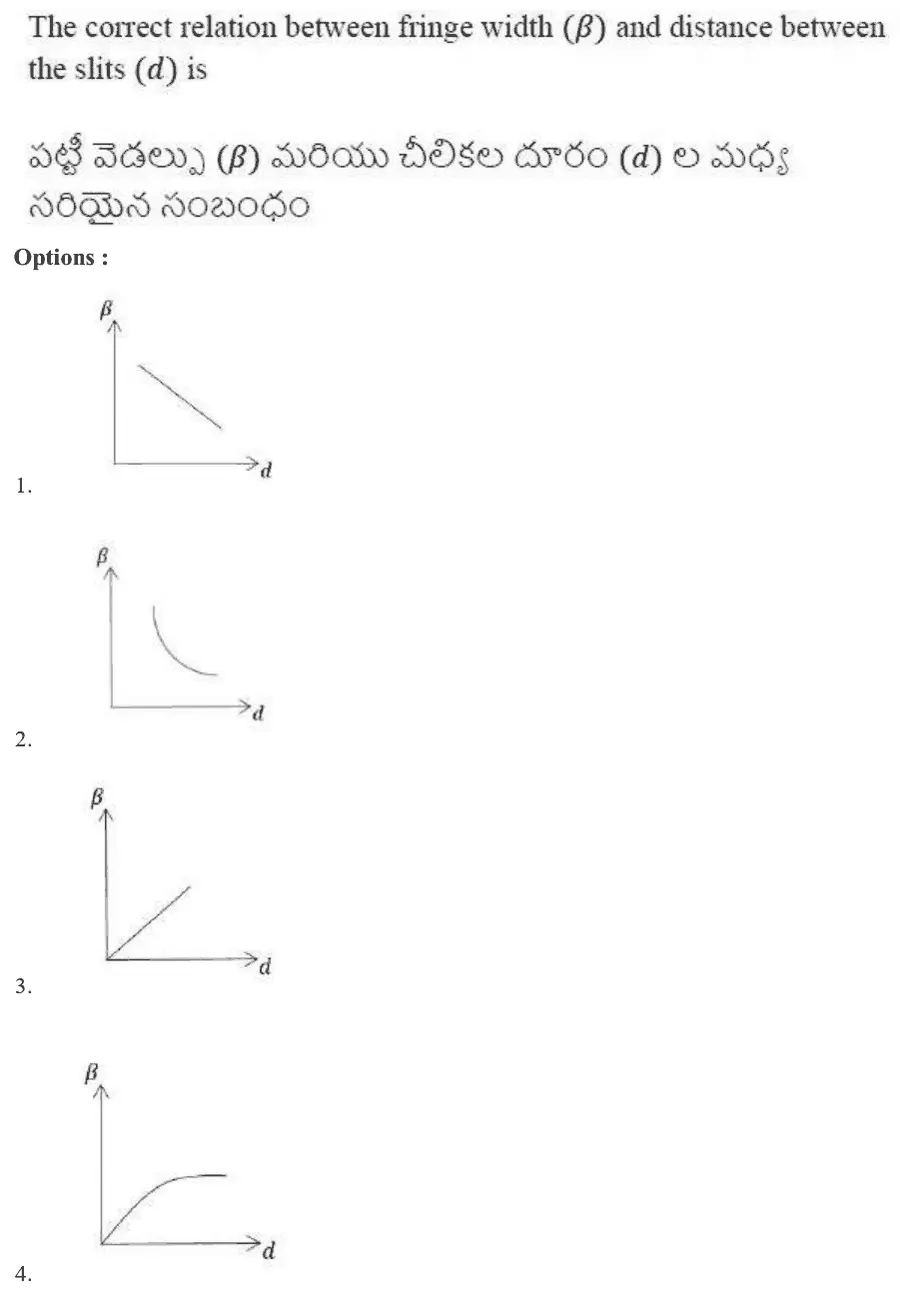
The question and its figure as printed in AP EAPCET 2026 13th May 2026 Shift 2. Option 1: Graph with β on the vertical axis and d on the horizontal axis: a straight line with negative slope, starting at a point above the horizontal axis (not touching either axis) and sloping downward to the right. Option 2: Graph with β on the vertical axis and d on the horizontal axis: a decreasing curve (hyperbola-like, convex), steep at first and flattening toward the right, not touching either axis. Option 3: Graph with β on the vertical axis and d on the horizontal axis: a straight line with positive slope starting from the origin. Option 4: Graph with β on the vertical axis and d on the horizontal…
The question as printed in the paper.
  1. (1)

    see figure Graph with $\beta$ on the vertical axis and $d$ on the horizontal axis: a straight line with negative slope, starting at a point above the horizontal axis (not touching either axis) and sloping downward to the right.

  2. (2)

    see figure Graph with $\beta$ on the vertical axis and $d$ on the horizontal axis: a decreasing curve (hyperbola-like, convex), steep at first and flattening toward the right, not touching either axis.

  3. (3)

    see figure Graph with $\beta$ on the vertical axis and $d$ on the horizontal axis: a straight line with positive slope starting from the origin.

  4. (4)

    see figure Graph with $\beta$ on the vertical axis and $d$ on the horizontal axis: a curve starting at the origin, rising steeply and then flattening to a constant (saturating) value.

Show answer

Option (2) is correct.

The council's preliminary key

See the step-by-step solution in EdLoop

The worked solution is in the EdLoop app, free on Android, with every other Wave Optics question from 2010 to 2026.

More from this chapter

All 136 questions in Wave Optics ›

Physics Wave Optics question from AP EAPCET 2026 (13th May 2026 Shift 2) (AP EAPCET exam). This is the paper as APSCHE held it.

All EAPCET Wave Optics PYQs (136 questions)

Get EdLoop – freeOpen on the web