
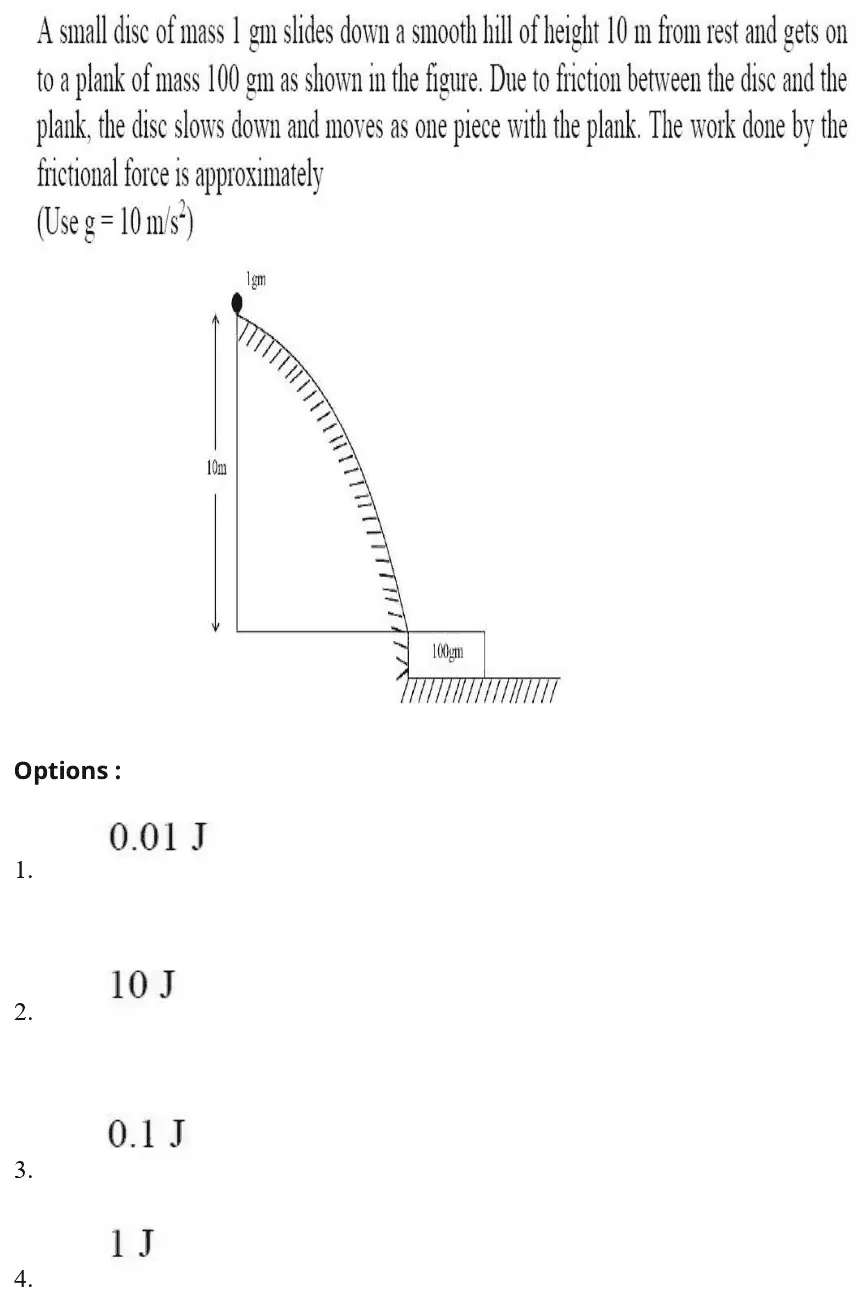
A small disc of mass $1\ \mathrm{gm}$ slides down a smooth hill of height $10\ \mathrm{m}$ from rest and gets on to a plank of mass $100\ \mathrm{gm}$ as shown in the figure. Due to friction between the disc and the plank, the disc slows down and moves as one piece with the plank. The work done by the frictional force is approximately (Use $g=10\ \mathrm{m/s^2}$)
(see the figure above)
- (1)
$0.01\ \mathrm{J}$
- (2)
$10\ \mathrm{J}$
- (3)
$0.1\ \mathrm{J}$
- (4)
$1\ \mathrm{J}$
Show answer
Option (3) is correct.
The council's preliminary key