
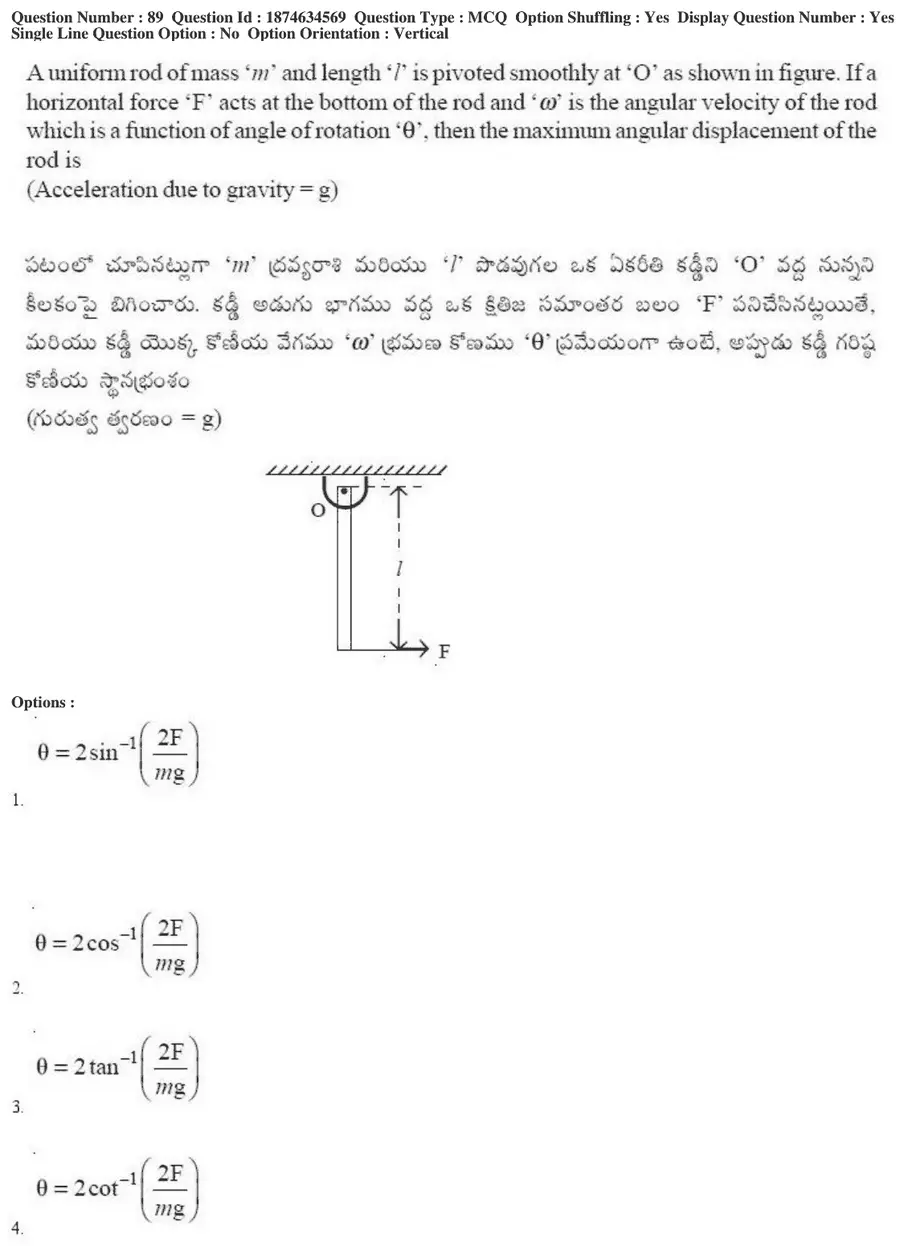
A uniform rod of mass '$m$' and length '$l$' is pivoted smoothly at 'O' as shown in figure. If a horizontal force 'F' acts at the bottom of the rod and '$\omega$' is the angular velocity of the rod which is a function of angle of rotation '$\theta$', then the maximum angular displacement of the rod is (Acceleration due to gravity $= g$)
(see the figure above)
- (1)
$\theta = 2\sin^{-1}\left(\frac{2F}{mg}\right)$
- (2)
$\theta = 2\cos^{-1}\left(\frac{2F}{mg}\right)$
- (3)
$\theta = 2\tan^{-1}\left(\frac{2F}{mg}\right)$
- (4)
$\theta = 2\cot^{-1}\left(\frac{2F}{mg}\right)$
Show answer
Option (3) is correct.
Official APSCHE final key