
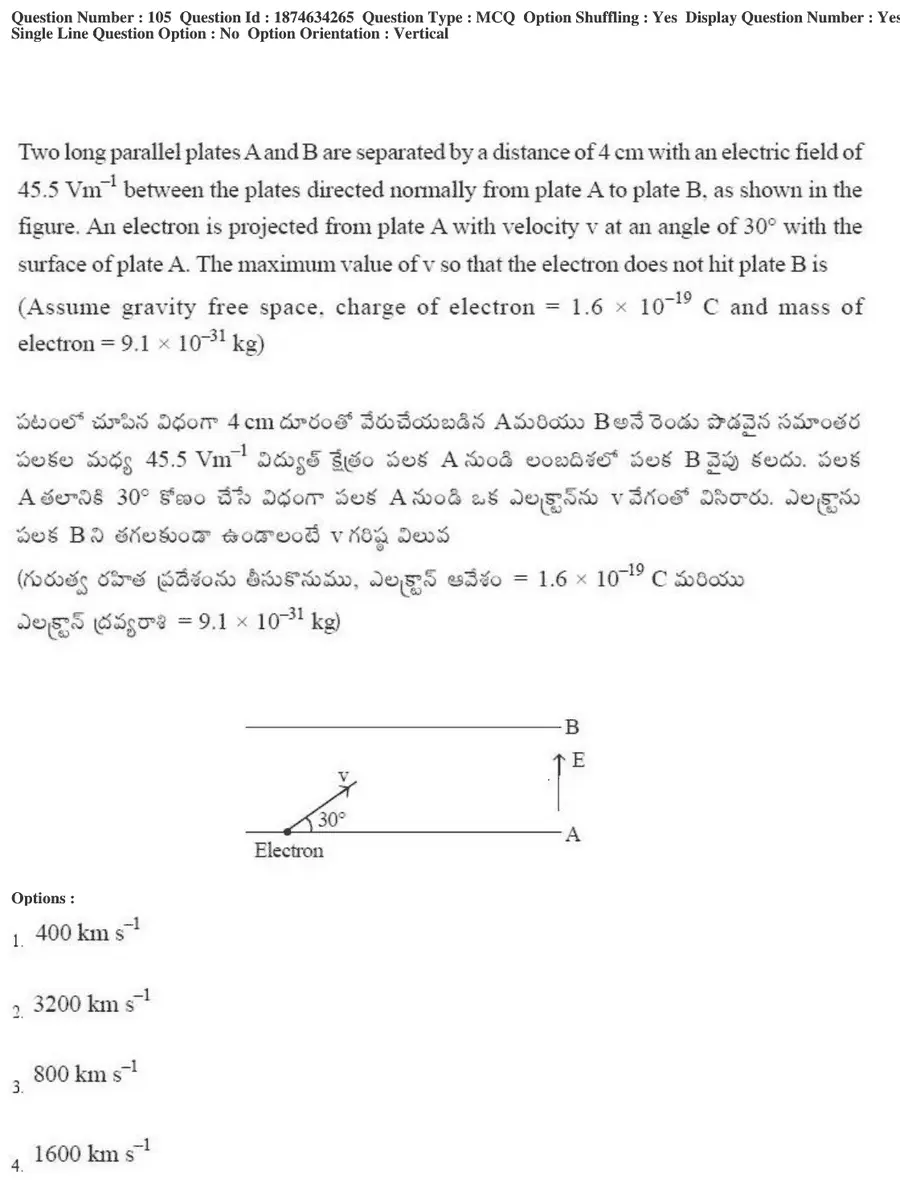
Two long parallel plates A and B are separated by a distance of 4 cm with an electric field of $45.5\ \mathrm{Vm^{-1}}$ between the plates directed normally from plate A to plate B, as shown in the figure. An electron is projected from plate A with velocity v at an angle of $30^\circ$ with the surface of plate A. The maximum value of v so that the electron does not hit plate B is
(Assume gravity free space, charge of electron $= 1.6\times10^{-19}\ \mathrm{C}$ and mass of electron $= 9.1\times10^{-31}\ \mathrm{kg}$)
(see the figure above)
- (1)
$400\ \mathrm{km\,s^{-1}}$
- (2)
$3200\ \mathrm{km\,s^{-1}}$
- (3)
$800\ \mathrm{km\,s^{-1}}$
- (4)
$1600\ \mathrm{km\,s^{-1}}$
Show answer
Option (4) is correct.
Official APSCHE final key